
The Addams Family of the 1990s: Barry Sonnenfeld’s Film Adaptation
After the beloved television series aired its last episode in 1965, the 30-year trend cycle brought the Addams Family back into the zeitgeist in the 1990s. Before your next Addams Family marathon, prime yourself on the history of the Sonnenfeld films and their historical context.
The Addams Family Hits the Big Screen
The 1990s saw a film reboot of The Addams Family franchise with The Addams Family (1991) and The Addams Family Values (1993), both under the direction of Barry Sonnenfeld. The film made history casting Puerto Rican actor Raúl Julia as Gomez Addams, finally affirming the character’s Latino heritage (Zornosa, 2022). Julia was joined by Academy Award-winner Anjelica Huston as Morticia Addams and Emmy Award-winner Christopher Lloyd as Uncle Fester (Sonnenfeld, 1991; Sonnenfeld, 1993). Young Christina Ricci played Wednesday – a role that would define her career – and Jimmy Workman played Pugsley Addams (Sonnenfeld, 1991; Sonnenfeld, 1993). Finally, Carel Struycken played Lurch (Sonnenfeld, 1991; Sonnenfeld, 1993). In the first film, the family is conned by a man posing as the Addams’s long-lost Uncle Fester in order to steal the estate (Sonnenfeld, 1991). For its sequel, Addams Family Values, Pugsley and Wednesday are sent to a classic all-American summer camp (Sonnenfeld, 1993).
Fun Fact: Sonenfeld’s The Addams Family (1991) and The Addams Family Values (1993) continued the trend of Hollywood nepo-hires in Addams adaptations, as Morticia Addams actress Anjelica Huston is the daughter of legendary Academy Award-winning director John Huston, who – in turn – was the son of the Academy Award-winning actor Walter Huston (Gates, 2006; Meares, 2025).
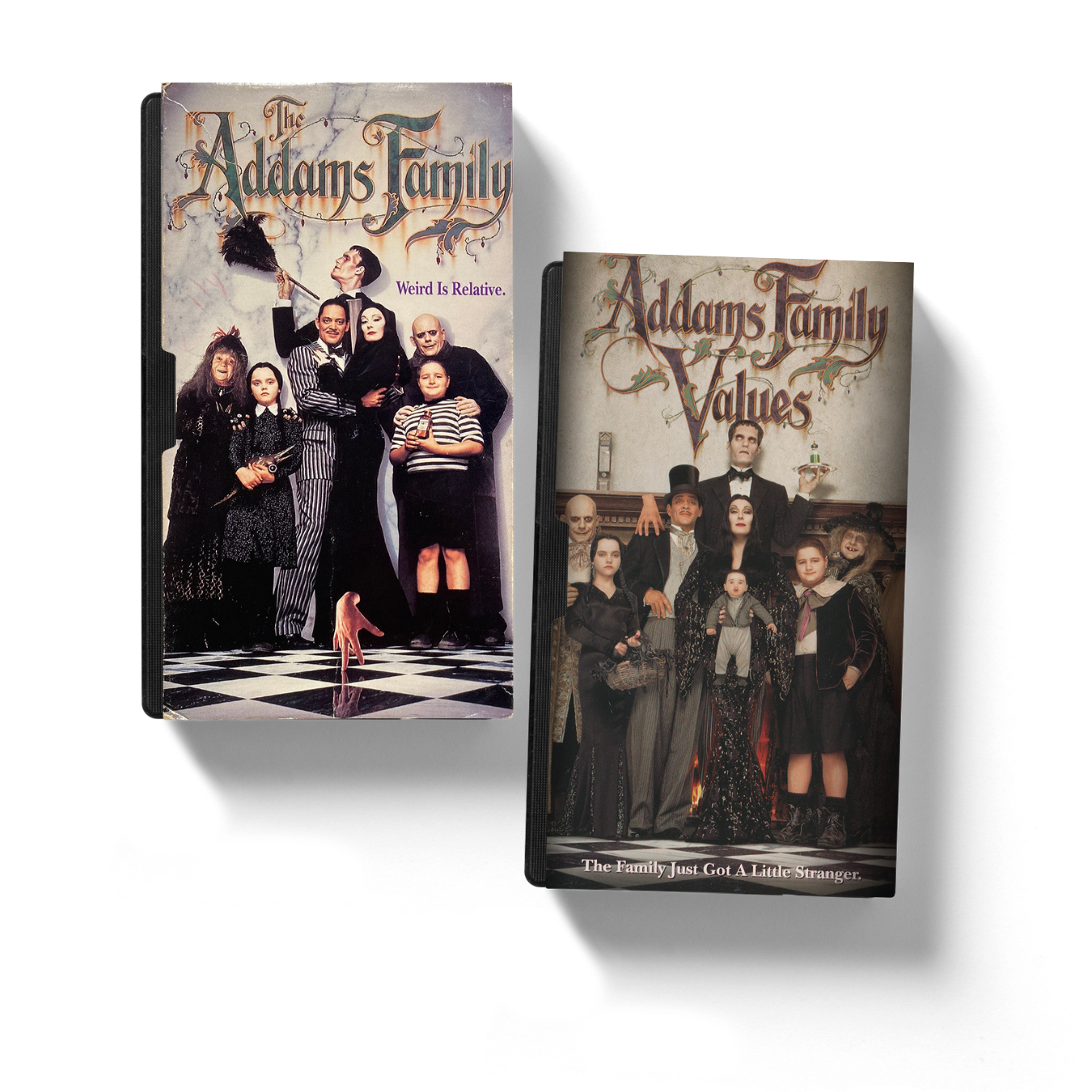
The Addams vs. Family Values
While the two Sonnenfeld Addams Family films were released in 1991 and 1993, they began production in 1989 and had been unofficially in the works even earlier (AFI Catalog, n.d.). Thus, they provide more of a retrospective critique on 1980s culture rather than the contemporaneous early 1990s. Much like their 1960s television counterparts, the 1990s films satirized the white-picket-fence, suburban optimism found in the sitcoms and family comedies that dominated the media landscape in a post-war America.
However, the films’ critiques were much more sharp than the television shows’, and took direct jabs at modern politicians. In an interview with The Hollywood Reporter, screenwriter Paul Rudnick affirmed he intended for the title of the sequel, Addams Family Values, to mock George H.W. Bush’s 1988 “family values” presidential campaign (Abrams, 2018).
The Sonnenfeld films’ commentary on American conservatism went beyond the title. In one of the most memorable scenes of the film, Wednesday disrupts the summer camp’s patriotic Thanksgiving play to instead call attention to the atrocities the American government committed in eradicating Native Peoples from the land (Sonnenfeld, 1993). Rudnick noted the scene was “Wednesday Addams’ ultimate revenge, on Republicans, blondes, mean girls and bullies” (Abrams, 2018). Still, critics at the time noted that the Addams Family unit, “which embodies so many wrong values, still has as its bedrock the sanctity of hearth and home” (Klady, 1993).
The Addams Family Says “Nope” to the Yuppie
Remembered for its rampant materialism and consumerism with the rise of the “yuppie,” or “young urban professional,” and shopping malls, the 1980s provided the perfect contrast for Charles Addams's gothic characters (Onion et al., 2018). Fashions of the decade were marked by exaggerated silhouettes, bold colors, clashing patterns, and powersuits (Ramzi, 2024). Meanwhile, the Addams Family maintained their dark, gothic aesthetic, often sporting vintage pieces rather than new mall-bought garb.
Production designers Richard Macdonald (The Addams Family, 1991) and Ken Adam (Addams Family Values, 1993) took full advantage of the medium to create visual contrast between the morose Addams Family and the vibrant late-1980s setting. Moreover, color film allowed the Addamses to visually oppose their suburbanite competitors to a greater degree than ever before.
-
Abrams, S. (2018, Nov. 21). “The Hidden Message of ‘Addams Family Values.’” The Hollywood Reporter. https://www.hollywoodreporter.com/movies/movie-news/addams-family-values-had-secret-political-message-reveals-writer-1162918/.
AFI Catalog. (n.d.). “The Addams Family (1991).” AFI Catalog of Feature Films. https://catalog.afi.com/Catalog/moviedetails/58747#:~:text=An%208%20Feb%201991%20DV,Court%20Motel%20in%20Sylmar%2C%20CA.
Gates, A. (2006, Aug. 18). “The Huston Family: 75 Years on Film.” The New York Times. https://web.archive.org/web/20201109041227/https://www.nytimes.com/2006/08/18/movies/18bmovi.html.
Hartley, M. & Piesman, M. (1984). The Yuppie Handbook: The State-of-the Art Manual for Young Urban Professionals. Long Shadow Books.
Klady, L. (1993, Nov. 11). “Addams Family Values.” Variety. https://variety.com/1993/film/reviews/addams-family-values-1200434365/.
Meares, H.H. (2025, Oct. 9). “Glamour and Grit: Anjelica Huston’s Cultured Coolness.” Vanity Fair. https://www.vanityfair.com/hollywood/story/anjelica-huston-memoirs?srsltid=AfmBOopIg_UQ8hdHT0dz_v4mRCBdc3YDrQ83eyyp71cXGQAtd2eL80Nd.
Ramzi, L. (2024, May, 20). A 1980s Fashion History Lesson: Lycra, Power Suits, and Clothing as Concept. Vogue. https://www.vogue.com/article/1980s-fashion-history-lesson.
Sonnenfeld, B. (Director). (1991). The Addams Family [Film]. Orion Pictures & Paramount Pictures.
Sonnenfeld, B. (Director). (1993). The Addams Family Values [Film]. Paramount Pictures.
Zornosa, L. (2022, Nov. 23). “Wednesday Reboots the Addams Family With a Biting Condemnation of Colonialism—Just in Time For Thanksgiving.” TIME. https://time.com/6236655/wednesday-netflix-addams-family-legacy/.