
A Brief History of “The Addams Family” Television Series
Conducting dramaturgical research is fun for any show, but especially so when you have the opportunity to dive into a beloved franchise whose history spans page, screen, and stage like Charles Addams’s Addams Family. In 2010, the iconic mysterious and spooky characters graced the Broadway stage in The Addams Family, a musical comedy with music and lyrics by Andrew Lippa and book by Marshall Brickman and Rick Elice. The Broadway adaptation borrows greatly from its television and film live-action predecessors, making them both essential viewing for any fan or participant in the stage play. Before beginning your Addams Family watch party, dive into this brief history of the iconic series.
The Addams Family Hits the Airwaves
The first episode of The Addams Family, "The Addams Family Goes to School," premiered on ABC in 1964 starring Carolyn Jones as Morticia; John Astin as Gomez; Jackie Coogan as Uncle Fester; Lisa Loring as Wednesday; Ken Weatherwax as Pugsley, and Ted Cassidy as Lurch (Levy, 1964-1966). The show featured an inverted fish-out-of-water sitcom premise, existing in a “a self-contained house of horrors where normal folk were the outsiders that allowed for all manner of off-beat jokes, insane plots” (Sauer, 2019). Much of the show’s comedy was shaped by writer, director, and producer Nat Perrin, who was previously best known for his work on the Marx Brothers comedy Monkey Business (Sauer, 2019). Composer Vic Mizzy provided the iconic four-note bass line “ba-da-da-dum snap snap” theme song, which is perhaps the most memorable contribution from the series (1964-1966).
Fun Fact: The Addams Family began the trend of meta-casting members of Hollywood royal families in live-action adaptations of the comics. Gomez Addams actor John Astin was married to Academy and Emmy award-winning actress Patty Duke and became the adoptive father of Goonies and The Lord of the Rings star John Astin (Tremaine, 2024).
A Monster Revival
ABC’s The Addams Family was born during an early 1960s revival of “monster culture,” which had first taken root in American media in the 1930s as a response to the Great Depression (Morowitz, 2007, p. 38). Hollywood’s initial obsession with the genre was led by Universal Pictures, which released 8 new creature feature films between 1930 and 1939 and established its own Universal Classic Monsters franchise. In 1957, Universal licensed its Monsters catalogue for syndication under the Shock! Theatre television package, renewing the public’s interest in the film franchises and strange stories (Zatoichi01, 2019; Cronin, 2025).
This time, the popularity of fantasy and science fiction spawned as a response to the idyllic, prosperous, and falsely utopian postwar Eisenhower administration. During this 1960s monster revival, film and television explored “the normal in the freakish and the freakish in the normal” (Morowitz, 2007, p. 41). Creatures were inversions of ordinary people — such as the beautiful giantess in Nathan Hertz’s Attack of the 50 Foot Woman (1958), the suburban witch on Bewitched (Ackerman, 1964-1972), and the man-eating plant in Roger Corman’s Little Shop of Horrors (1960) — rather than ancient monsters of classic literature. New shows such as The Addams Family (Levy, 1964-1966), I Dream of Jeannie (Sheldon, 1965-1970), and The Munsters (Connelly & Mosher, 1964-1966) starkly contrasted the “conflict-free and homogenised vision of the American family” seen in Father Knows Best (Young & Rodney, 1954-1960), Leave it to Beaver (Connelly & Mosher, 1957-1961), The Adventures of Ozzie and Harriet (1952-1966), and The Donna Reed Show (Owen, 1958-1966), which served as advertisements for suburban life (Morowitz, 2007, p. 35).
Mother Knows Best on The Addams Family
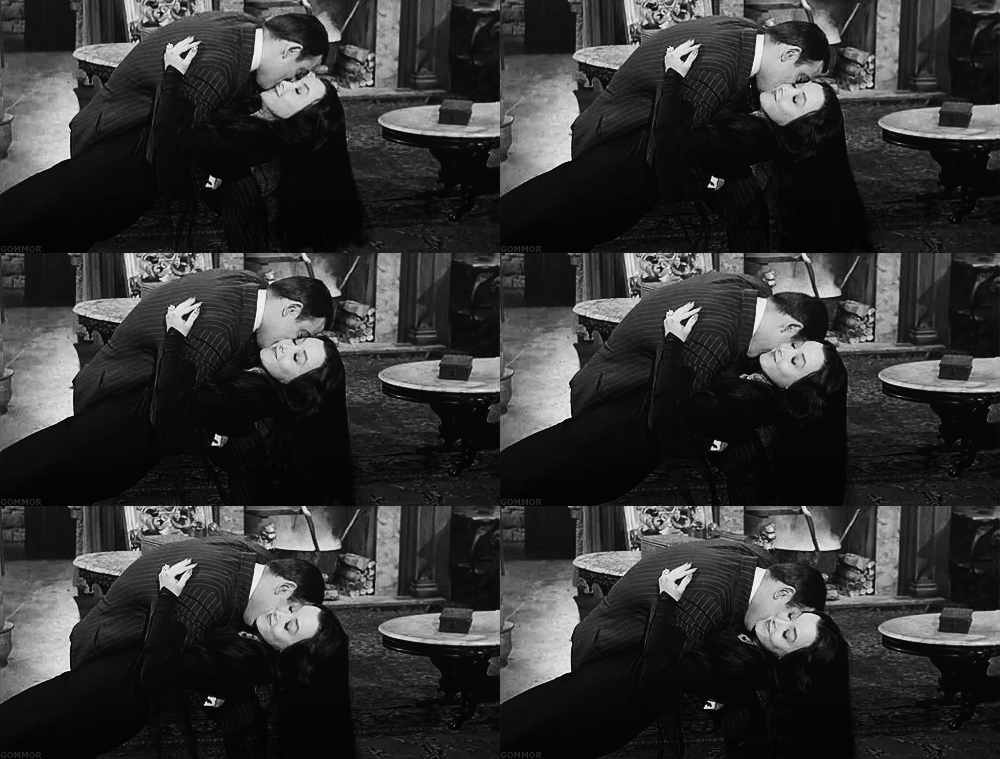
The Addams Family went further than its competitors in challenging American family rearing expectations. Unlike Father Knows Best or the Dick Van Dyke Show — which were named for the men of the families — Morticia Addams is the leader of the house in The Addams Family, and Gomez worships her. Like in the original cartoons, Gomez defers to his wife for guidance and hangs on her every word, hoping for the chance to hear her seductive French — in a running gag throughout the series, Gomez declares “Tish, you spoke French!” and rushes to kiss up her arm any time Morticia speaks the romantic language (FETV, 2021). Meanwhile, couples on other popular sitcoms slept in separate beds to promote an image of chastity. In fact, Gomez and Morticia Addams in The Addams Family “are generally considered the first television couple who gave the appearance of an active sex life” (Sauer, 2019).
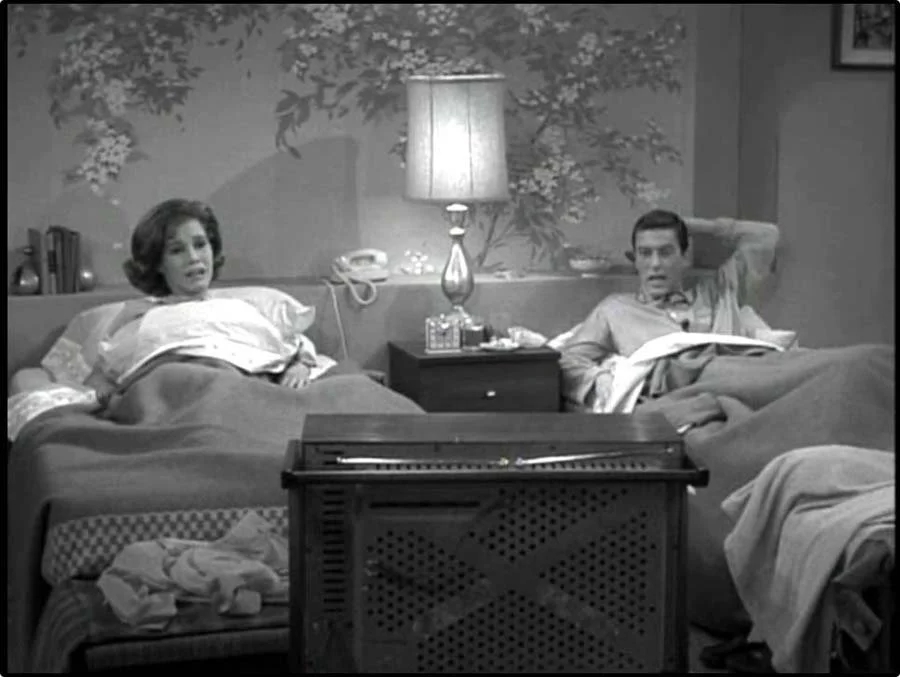
Rich, J. (Director). (1962, Jan. 3). Season 1, Episode 15 of The Dick Van Dyke Show, “Where Did I Come From?” Reiner, C. (Teleplay).
Moreover, while fathers on other series were shown to leave for work, Gomez Addams is “ever present in the household” (Morowitz, 2007, p. 46). The season one episode “Morticia, the Breadwinner” (Lanfield, 1965) addresses this topic, revealing Gomez to be a stock investor and Morticia to have family money in the railroad industry, enabling both parents to remain at home with the children.
They’re Altogether Ooky, But They’re All Together
Despite their critiques of the American family, the Addamses had a life worthy of envy. The show highlighted the “strong family values” that had been evident throughout Charles Addams’s original illustrations – the family spent time together, they loved each other, and they have “morals that keep the family unit intact” (Miserocchi, 2010, p. 16). The show affirmed that the “refusal to conform” only brings “a family more strongly together” (Morowitz, 2007, p. 53). Unfortunately, the show was cancelled in 1966, airing 64 episodes in total (Sauer, 2019). Still, it’s remembered as one of the most beloved American television series to this day, with ballpark stadiums nationwide playing the theme song to rouse crowds.
The Addams Family stage musical pays homage to many elements from the television show, including Gomez’s physical displays of affection for Morticia; using the inverted fish-out-of water format with outsiders scrutinizing the Addams Family home; and interpolating the iconic Vic Mizzy theme.
-
Connelly, J. & Mosher, B. (Executive producers). (1964-1966). The Munsters [Television series]. Kayro-Vue Productions; Universal Television.
Connelly, J. & Mosher, B. (Executive producers). (1957-1961). Leave It to Beaver [Television series]. Gomalco Productions; Kayro-Vue Productions.
Corman, R. (Director). (1960, Sept. 14). Little Shop of Horrors [Film]. The Filmgroup & Santa Clara Productions.
Cronin, B. (2025, Oct. 25). “The Forgotten Cult Classic That Quietly Resurrected Universal Monsters.” CBR. https://www.cbr.com/universal-monsters-shock-theater-syndication-package/.
FETV. (2021, Feb. 3). “‘Tish, You Spoke French!’ | The Addams Family” [Video]. YouTube. http://youtube.com/watch?v=1-rUOrKviOM.
Hertz, N. (Director). (1958, May 18). Attack of the 50 Foot Woman [Film]. Woolner Bros. Pictures.
Leonard, S. (Executive producer). (1961–1966). The Dick Van Dyke Show [Television Series]. Calvada Productions & CBS Television Network.
Levy, D. (Executive producer). (1964-1966). The Addams Family [Television series]. Filmways Television; MGM Television.
Morowitz, L. (2007). The Monster Within: The Munsters, The Addams Family and the American Family in the 1960s. Critical Studies in Television, 2(1), 35-56. https://doi-org.ezproxy.csusm.edu/10.7227/CST.2.1.5.
Nelson, O. (Executive producer). (1952-1966). The Adventures of Ozzie and Harriet [Television series]. Stage Five Productions; Volcano Productions; ABC Productions.
Owen, T. (Executive producer). (1958-1966). The Donna Reed Show [Television series]. Todon of California; Briskin Productions.
Sauer, P. (2019, Oct. 11). “The Cultural History of ‘The Addams Family.’” Smithsonian Magazine. https://www.smithsonianmag.com/arts-culture/cultural-history-addams-family-180973315/.
Sheldon, S. (Executive producer). (1965-1970). I Dream of Jeannie [Television series]. Screen Gems; Sidney Sheldon Productions.
Tremaine, J. (2024, Aug. 15). “All About Sean Astin's Famous Parents, Patty Duke, John Astin and Michael Tell.” People. https://people.com/all-about-sean-astin-parents-8673689.
Zatoichi01. (2019, Oct. 21). “Shock! (Pressbook) [1957] (Screen Gems)” [Image]. Internet Archive. Original work published 1957. Retrieved Mar. 1, 2026, from https://archive.org/details/shockpressbook1957screengems/Shock%21%20%28Pressbook%29%20%5B1957%5D%20%28Screen%20Gems%29/page/n1/mode/2up.
Young, R. & Rodney, E.B. (Executive producers). (1954-1960). Father Knows Best [Television series]. Rodney-Young Productions; Screen Gems.