
Meet the Addams Family
While today best known for its live-action television and film adaptations, the Addams Family franchise began as a series of comics by New Yorker cartoonist Charles “Chas” Addams. In the magazine’s August 6, 1938 edition, Addams published what would be his first Addams Family cartoon: an image of a salesman pitching a “noiseless, vibrationless” vacuum to a witch-like, Bride-of-Frankenstein woman and her large butler in the foyer of a haunted Victorian home (p. 9). Though unnamed in this comic, these characters would later become Morticia Addams and Lurch.
The Anti-Rockwell Family
In the foreword to The Addams Family: An Evilution, author and Director of the Tee and Charles Addams Foundation H. Kevin Miserocchi writes, “Charles Addams set out not to create a family but rather to suggest how society as a whole might interpret characters bent on the darker side while living lives similar to those embracing the light” (2010, p. 9). However, in creating a family of outcasts, Addams birthed a franchise that would win over the hearts of America. Charles Addams intended for the Addams family to be “a funhouse-mirror reflection of American culture,” but American culture embraced the family, instead (KalaLea, 2019). The Addams Family was a weird bunch, but they were just like us. Miserocchi continues:
“Always described as strange, eerie, odd, and spooky, the Family nevertheless had many of the same joys and woes that all families experience… They celebrated Christmas just as eagerly as Halloween, just with their own traditions. What would an Addams Family Christmas be without lighting a fire in the fireplace in anticipation of Santa’s arrival, or pouring boiling oil on the neighborhood carolers? They really weren’t that different after all” (2010, p. 10).

Addams, C. (1947, Dec. 27). “Addams Family Christmas Dinner” [Illustration]. The New Yorker, p. 21. https://archives.newyorker.com/newyorker/1947-12-27/flipbook/020/.
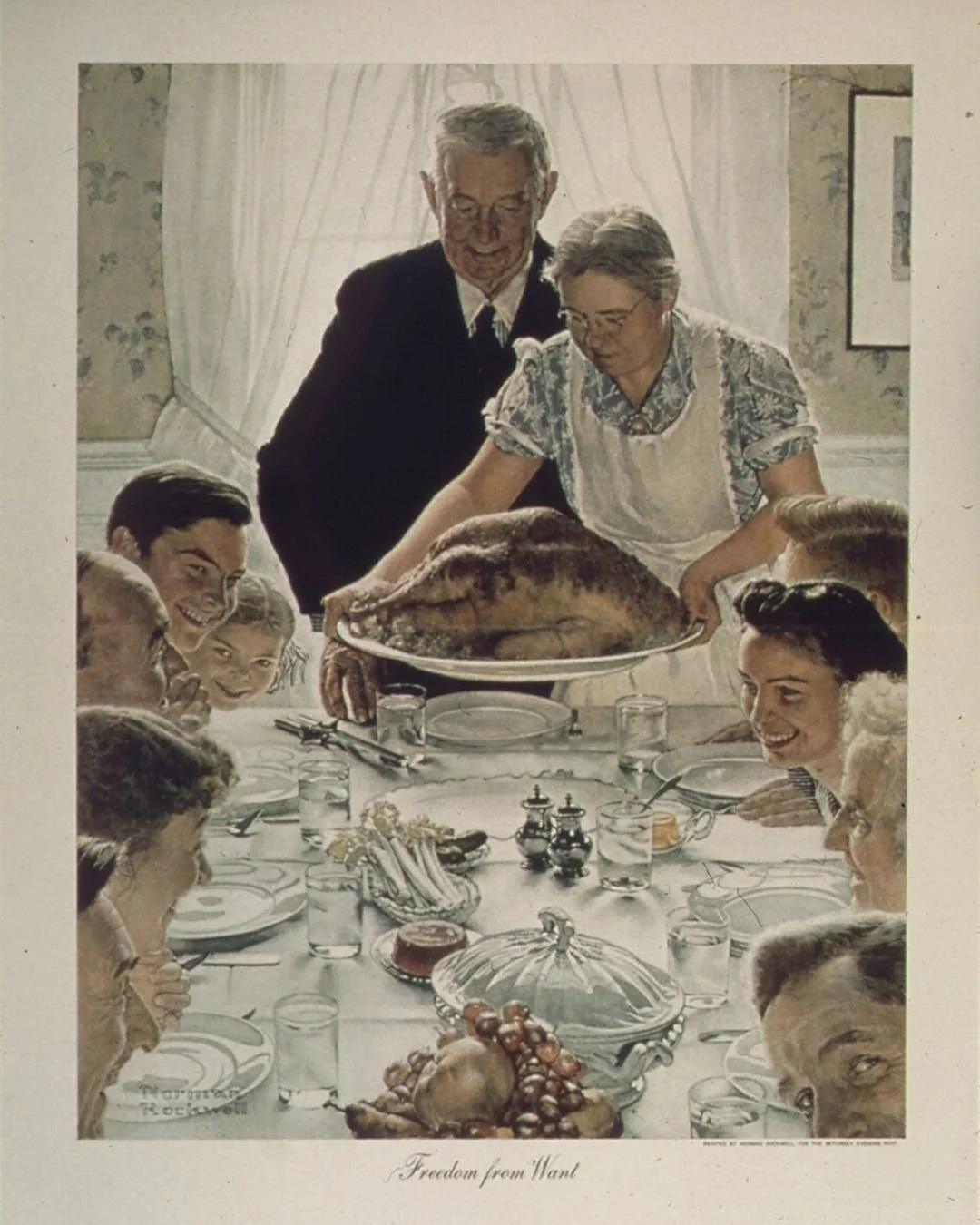
Rockwell, N. (1943, Mar. 6). “Freedom from Want” [Oil Painting]. The Saturday Evening Post. https://upload.wikimedia.org/wikipedia/commons/9/95/%22Freedom_From_Want%22_-_NARA_-_513539.jpg.
Morticia Addams
Morticia Addams was the first member of the Addams Family created by Charles Addams, making her New Yorker debut on August 6, 1938 (p. 9). Addams described Morticia as “the real head of the family and the critical and moving force behind it” (Miserocchi, 2010). Morticia is “low-voiced, incisive, and subtle,” rarely smiling and avoiding cliches (Miserocchi, 2010, p. 44). She has long, sleek, dark hair and wears a seductive black form-fitting gown with a tattered tentacle train – a “glamorous femme fatale” (Miserocchi, 2010, p. 44).
![Addams, C. (1938, Aug. 6). “Vibrationless, Noiseless, and a great time…” [Illustration]. The New Yorker, p. 9. https://archives.newyorker.com/newyorker/1938-08-06/flipbook/8/. (Copy)](https://images.squarespace-cdn.com/content/v1/6515c98fe1bbd91be575282e/124f8722-e1af-49ca-9b5b-bad96a6d6e16/Noiseless%2C+vibrationless%2C+The+New+Yorker%2C+Aug.+6%2C+1938.jpg)
![Addams, C. (1945, Apr. 14). “Oh, I couldn’t make it Friday…” [Illustration]. The New Yorker, p. 23. https://archives.newyorker.com/newyorker/1945-04-14/flipbook/022/. (Copy)](https://images.squarespace-cdn.com/content/v1/6515c98fe1bbd91be575282e/18c18299-bcf6-49d5-9234-ad48b080b8bd/Morticia-Fridaythe13th-Cartoon_1945.jpg)
![Addams, C. (1952, Feb. 9). “Morticia with Batcage” [Illustration]. The New Yorker, p. 40. https://archives.newyorker.com/newyorker/1952-02-09/flipbook/040/. (Copy)](https://images.squarespace-cdn.com/content/v1/6515c98fe1bbd91be575282e/8e11d484-1e38-4587-b6d4-40dcba8f609b/Morticia+with+Batcage%2C+The+New+Yorker%2C+Feb.+9%2C+1952.jpg)
![Addams, C. (1956, Jan. 28). “We won’t be late, Miss Weems” [Illustration]. The New Yorker, p. 27. https://archives.newyorker.com/newyorker/1956-01-28/flipbook/026/. (Copy)](https://images.squarespace-cdn.com/content/v1/6515c98fe1bbd91be575282e/88ac0179-5679-4719-a871-c20ceb5ea54a/We+Won%27t+Be+Late%2C+The+New+Yorker%2C+Jan.+28%2C+1956.jpg)
Gomez Addams
Gomez Addams first appeared in The New Yorker on November 14, 1942, in a comic with his beloved wife, Morticia. In the illustration, Gomez asks Morticia, “Are you unhappy, dear?” to which she replies, “Oh yes, yes! Completely!” (Addams, 1942, p. 27). According to creator Charles Addams, Gomez is “a crafty schemer” and “jolly man” who “tries hard to be father and teacher to the children, though sometimes misguided” (Miserocchi, 2010, p. 62). He is “sentimental and often puckish,” relying on Morticia to “straighten him out” (Miserocchi, 2010, p. 62). Gomez’s devotion to both his wife and his children comes into conflict in The Addams Family Musical; in the stage show, Gomez must keep Wednesday’s engagement a secret from Morticia, betraying her trust in the process.
![Addams, C. (1942, Nov. 14). “Are you unhappy, darling?” [Illustration]. The New Yorker, p. 27. https://archives.newyorker.com/newyorker/1942-11-14/flipbook/026/. (Copy)](https://images.squarespace-cdn.com/content/v1/6515c98fe1bbd91be575282e/d5fcdb14-9e13-4375-8da5-1708f6fcbea1/Are+you+unhappy+darling%2C+The+New+Yorker%2C+Nov.+14%2C+1942.jpg)
![Addams, C. (1950, May 27). “You see, chicks…” [Illustration]. The New Yorker, p. 35. https://archives.newyorker.com/newyorker/1950-05-27/flipbook/034/. (Copy)](https://images.squarespace-cdn.com/content/v1/6515c98fe1bbd91be575282e/82f71f51-0ce0-4e2f-b5aa-6e65dc50ead4/You+see%2C+chicks%2C+half+the+fun+is+in+making+it+yourself%2C+The+New+Yorker%2C+May+27%2C+1950.jpg)
![Addams, C. (1950, Dec. 30). “...then good old Scrooge…” [Illustration]. The New Yorker, p. 26. https://archives.newyorker.com/newyorker/1950-12-23/flipbook/026/. (Copy)](https://images.squarespace-cdn.com/content/v1/6515c98fe1bbd91be575282e/bdecb1aa-b627-491f-8f95-9977f131da68/Gomez+recites+A+Christmas+Carol%2C+The+New+Yorker%2C+Dec.+23%2C+1950.jpg)
![Addams, C. (1952, Mar. 1). “Just the kind of day that makes you feel good to be alive!” [Illustration]. The New Yorker, p. 31. https://archives.newyorker.com/newyorker/1952-03-01/flipbook/030/. (Copy)](https://images.squarespace-cdn.com/content/v1/6515c98fe1bbd91be575282e/1782366234669-A1FDEM5BX804Y8QIJ0II/%E2%80%9CJust+the+kind+of+day+that+makes+you+feel+good+to+be+alive%21%E2%80%9D+The+New+Yorker%2C+Mar.+1%2C+1952.jpg)
Wednesday Addams
Named for the 19th-century nursery rhyme “Monday’s Child,” Wednesday Addams is “full with woe” (Halliwell-Phillipps, J.O., 1849, p. 228). Charles Addams said the young Addams daughter is “a solemn child, prim in dress and, on the whole, pretty lost” (Miserocchi, 2010, p. 80). She is mysterious and imaginative, though prone to the occasional tantrum in the comics. According to Addams, Gomez has a secret soft spot for his daughter – a trait that was carried into the stage musical as Gomez struggles to accept his little girl is growing up (Miserocchi, 2010, p. 80).
![Addams, C. (1944, Aug. 26). “Well, don't come whining…” [Illustration]. The New Yorker, p. 29. https://archives.newyorker.com/newyorker/1944-08-26/flipbook/028/. (Copy)](https://images.squarespace-cdn.com/content/v1/6515c98fe1bbd91be575282e/1782366449694-AXMNAITMKAKRTFJ74WBX/Well%2C+don%27t+come+whining..._+The+New+Yorker%2C+Aug.+26%2C+1944.jpg)
![Addams, C. (1954, June 26). “Gomez pushing Wednesday on a broomstick swing” [Illustration]. The New Yorker, p. 23. https://archives.newyorker.com/newyorker/1954-06-26/flipbook/022/. (Copy)](https://images.squarespace-cdn.com/content/v1/6515c98fe1bbd91be575282e/1782366429321-LQ6S4EX4HFI4LYMF3VK0/The+New+Yorker%2C+June+26%2C+1954.jpg)
![Addams, C. (1954, Oct. 16). “Oh, she’s furious...” [Illustration]. The New Yorker, p. 25. https://archives.newyorker.com/newyorker/1954-10-16/flipbook/024/. (Copy)](https://images.squarespace-cdn.com/content/v1/6515c98fe1bbd91be575282e/1782366508524-CQJJX4D9U6ROABTNY3FK/The+New+Yorker%2C+Oct.+16%2C+1954.jpg)
![Addams, C. (1954, Nov. 6). “Wednesday with a loose tooth” [Illustration]. The New Yorker, p. 36. https://archives.newyorker.com/newyorker/1954-11-06/flipbook/036/. (Copy)](https://images.squarespace-cdn.com/content/v1/6515c98fe1bbd91be575282e/1782366552535-VAHF1X5Y1W18K9AKL4O5/Wednesday+has+a+loose+tooth%2C+The+New+Yorker%2C+Nov.+6%2C+1954.jpg)
Pugsley Addams
Charles Addams described Pugsley Addams as “an energetic monster of a boy about nine years old – blondish red hair, popped blue eyes and a dedicated troublemaker – in other words, the kid next door” (Miserocchi, 2010, p. 80). His favorite pastimes include building his own guillotines, poisoning his younger sister, and pranking bystanders with the Addams’s unusual pets (Miserocchi, 2010, p. 80). When illustrating the child, Addams had always called him “Pubert” (Miserocchi, 2010, p. 81). However, ABC wouldn’t approve of the name when adapting the Family for television, so Addams decided on “Pugsley” – after the Pugsley Creek in the Bronx – instead (Miserocchi, 2010, p. 81).
In the original comics, Pugsley Addams is the eldest child of the Addams Family, though The Addams Family Musical changed his role to younger brother. Though the musical does maintain Pugsley’s impish nature, this time directing his mischief toward thwarting his sister’s engagement so that she remains at home with him.
![Addams, C. (1948, Aug. 14). “Now kick Daddy good night and run along to bed” [Illustration]. The New Yorker, p. 31. https://archives.newyorker.com/newyorker/1948-08-14/flipbook/030/. (Copy)](https://images.squarespace-cdn.com/content/v1/6515c98fe1bbd91be575282e/1782366935378-CFIHB2XDGWQ1LMKJRFVB/Now+kick+daddy+goodnight%2C+The+New+Yorker%2C+Aug.+14%2C+1948.jpg)
![Addams, C. (1949, Dec. 24). “Wednesday and Pugsley on Christmas Day” [Illustration]. The New Yorker, p. 27. https://archives.newyorker.com/newyorker/1949-12-24/flipbook/026/. (Copy)](https://images.squarespace-cdn.com/content/v1/6515c98fe1bbd91be575282e/1782366955084-7XFAURQ9U5ECVXTCMA9R/Wednesday+and+Pugsley+on+Christmas+Morning%2C+The+New+Yorker%2C+Dec.+24%2C+1949.jpg)
![Addams, C. (1951, June 9). “All right, children, a nice big sneer, now” [Illustration]. The New Yorker, p. 37. https://archives.newyorker.com/newyorker/1951-06-09/flipbook/036/. (Copy)](https://images.squarespace-cdn.com/content/v1/6515c98fe1bbd91be575282e/1782366975340-MWFQV2PQUSN2PVUHG7EP/All+right%2C+children%2C+a+nice+big+sneer%2C+now%2C+The+New+Yorker%2C+June+9%2C+1951.jpg)
![Addams, C. (1945, Nov. 3). “Well, he certainly doesn’t take after my side of the family” [Illustration]. The New Yorker, p. 31. https://archives.newyorker.com/newyorker/1945-11-03/flipbook/030/ (Copy)](https://images.squarespace-cdn.com/content/v1/6515c98fe1bbd91be575282e/1782366991163-PIZBBJS5AF60Z01MRQEL/Well%2C+he+certainly+doesn%27t+take+after+my+side+of+the+family%2C+The+New+Yorker%2C+Nov.+3%2C+1945.jpg)
Lurch
Lurch is the lumbering, silent butler of the Addams Family. Of Lurch, Charles Addams said, “this towering mute has been shambling around the house forever” (Miserocchi, 2010, p. 118). While his character design favors Frankenstein’s monster, Lurch is not a monster of any sort; he adores the Addams children and faithfully dotes on the family, though not skillfully. He is “slow-witted but truly kind,” and until the television adaptation, Charles Addams had never even considered his appearance would be frightening to anyone (Miserocchi, 2010, p. 120).
![Addams, C. (1939, Nov. 25). “Oh, it’s you! For a moment you gave me quite a start” [Illustration]. The New Yorker, p. 16. https://archives.newyorker.com/newyorker/1939-11-25/flipbook/016/.  (Copy)](https://images.squarespace-cdn.com/content/v1/6515c98fe1bbd91be575282e/d2a1bf48-dec7-409d-b1a4-fbb6b3d80b7e/Oh%2C+it%27s+you%2C+The+New+Yorker%2C+Nov.+25%2C+1939.jpg)
![Addams, C. (1947, Aug. 30). “It's the children darling - back from camp” [Illustration]. The New Yorker, p. 21. https://archives.newyorker.com/newyorker/1947-08-30/flipbook/020/. (Copy)](https://images.squarespace-cdn.com/content/v1/6515c98fe1bbd91be575282e/db5a15bc-7fab-4689-afd5-2944713e21e7/It%27s+the+children+darling+-+back+from+camp%2C+The+New+Yorker%2C+Aug.+30%2C+1947.jpg)
![Addams, C. (1951, Sept. 29). “Lurch takes Pugsley to the schoolbus” [Illustration]. The New Yorker, p. 31. https://archives.newyorker.com/newyorker/1951-09-29/flipbook/030//. (Copy)](https://images.squarespace-cdn.com/content/v1/6515c98fe1bbd91be575282e/8a292f46-cbcb-4b3e-aa81-77ddc6b245b2/Lurch+takes+Pugsley+to+the+schoolbus%2C+The+New+Yorker%2C+Sept.+29%2C+1951.jpg)
![Addams, C. (1952, Nov. 22). “You forgot the eye of newt” [Illustration]. The New Yorker, p. 45. https://archives.newyorker.com/newyorker/1952-11-22/flipbook/044/. (Copy)](https://images.squarespace-cdn.com/content/v1/6515c98fe1bbd91be575282e/af99bb9c-a94b-4126-8b80-926ad52b095c/You+forgot+the+eye+of+newt%2C+The+New+Yorker%2C+Nov.+22%2C+1952.jpg)
Uncle Fester
Charles Addams called Uncle Fester an “incorrigible” fellow, who “except for the good nature of the family and the ignorance of the police, would ordinarily be under lock and key” (Miserocchi, 2010, p. 146). Despite this, Addams stated the character he related to most was, in fact, Uncle Fester (Miserocchi, 2010, p. 147). Uncle Fester’s favorite pastimes include fishing with dynamite, watching grotesque cinema, and playing with electricity (Miserocchi, 2010, p. 146-7).
![Addams, C. (1946, Mar. 23). “Fester at the cinema” [Illustration]. The New Yorker, p. 31. https://docs.google.com/document/d/1COHdnl-dZcRnaPADCvRds-QcK1w5NNqEGacnp7V2nE0/edit?tab=t.gal8x4uwpkrd (Copy)](https://images.squarespace-cdn.com/content/v1/6515c98fe1bbd91be575282e/894811d8-5e7a-4f54-88ab-745c50f36fb6/Fester+at+the+movies%2C+The+New+Yorker%2C+Mar.+23%2C+1946.jpg)
![Addams, C. (1950, Feb. 11). “Fester Dreaming of Sheep” [Illustration]. The New Yorker, p. 27. https://archives.newyorker.com/newyorker/1950-02-11/flipbook/026/. (Copy)](https://images.squarespace-cdn.com/content/v1/6515c98fe1bbd91be575282e/93667683-2150-4073-846f-b31b3b7b9c78/Fester+Dreaming+of+Sheep%2C+The+New+Yorker%2C+Feb.+11%2C+1950.jpg)
![Addams, C. (1964, July 18). “Fester visits North Haven Marina” [Illustration]. The New Yorker, p. 31. https://archives.newyorker.com/newyorker/1964-07-18/flipbook/030/. (Copy)](https://images.squarespace-cdn.com/content/v1/6515c98fe1bbd91be575282e/1840709e-6c76-4247-b403-28f7fdf2549d/Fester+visits+North+Haven+Marina%2C+The+New+Yorker%2C+Sept.+19%2C+1953.jpg)
![Addams, C. (1953, Sept. 19). “Fester and the children visit the lake” [Illustration]. The New Yorker, p. 21. https://archives.newyorker.com/newyorker/1953-09-19/flipbook/020/. (Copy)](https://images.squarespace-cdn.com/content/v1/6515c98fe1bbd91be575282e/9b06a79c-efd8-4839-8b12-1f4b41bc6b02/Fester+and+the+children+at+the+lake%2C+The+New+Yorker%2C+Sept.+19%2C+1953.jpg)
![Addams, C. (1973, Feb. 17). “Fester with his electronics” [Illustration]. The New Yorker, p. 41. https://archives.newyorker.com/newyorker/1973-02-17/flipbook/040/. (Copy)](https://images.squarespace-cdn.com/content/v1/6515c98fe1bbd91be575282e/10f07358-2c0e-4cfb-be36-49d30b46c6c0/Fester+with+his+electronics%2C+The+New+Yorker%2C+Feb.+17%2C+1973.jpg)
Grandma Frump, or Grandmama
According to Charles Addams, Grandma Frump is a “disrespectful old hag” and “good humored about all and can be garrulous” (Miserocchi, 2010, p. 128). In the comics, she is Gomez’s mother, though her relationship to the Family changes throughout iterations of the franchise (Miserocchi, 2010, p. 128). Addams said she is a favorite of the children and “willingly helps with the dishes, cheats at solitaire and is thoroughly dishonest” (Miserocchi, 2010, p. 128). In The Addams Family Musical, Grandmama provides the truth serum that creates the chaos of the second act.
![Addams, C. (1948, Jan. 24). “Grandma Frump and the Addams children bake cookies” [Illustration]. The New Yorker, p. 23. https://archives.newyorker.com/newyorker/1948-01-24/flipbook/022/.& (Copy)](https://images.squarespace-cdn.com/content/v1/6515c98fe1bbd91be575282e/356a6027-7551-4596-b2ea-556813d0665a/Grandma+Frump+and+the+Addams+children+bake+cookies%2C+The+New+Yorker%2C+Jan.+24%2C+1948.jpg)
![Addams, C. (1948, Jan. 10). “Grandma Frump does some sewing” [Illustration]. The New Yorker, p. 29. https://archives.newyorker.com/newyorker/1948-01-10/flipbook/028/. (Copy)](https://images.squarespace-cdn.com/content/v1/6515c98fe1bbd91be575282e/67e67a0a-07a1-44ce-b295-2854d253eee1/Grandma+Frump+does+some+sewing%2C+The+New+Yorker%2C+Jan.+10%2C+1948.jpg)
![Addams, C. (1951, Apr. 14). “Then the dragon gobbled up the handsome young prince…” [Illustration]. The New Yorker, p. 37. https://archives.newyorker.com/newyorker/1951-04-14/flipbook/036/.&nbs (Copy)](https://images.squarespace-cdn.com/content/v1/6515c98fe1bbd91be575282e/50031aba-5fe0-468d-bcc3-f9c7e4740cc7/Then+the+dragon+gobbled+up+the+handsome+young+prince%2C+The+New+Yorker%2C+Apr.+14%2C+1951.jpg)
![Addams, C. (1959, Oct. 17). “Grandmother! You’re not cheating!” [Illustration]. The New Yorker, p. 45. https://archives.newyorker.com/newyorker/1959-10-17/flipbook/044/. (Copy)](https://images.squarespace-cdn.com/content/v1/6515c98fe1bbd91be575282e/8c0ac25e-8a49-4b6f-82a6-7ec33dd5106b/Grandmother%21+You%E2%80%99re+not+cheating%2C+The+New+Yorker%2C+Oct.+17%2C+1959.jpg)
-
Addams, C. (1938, Aug. 6). “Vibrationless, Noiseless, and a great time…” [Illustration]. The New Yorker, p. 9. https://archives.newyorker.com/newyorker/1938-08-06/flipbook/8/.
Addams, C. (1946, Dec. 21). “Addams Family pours boiling oil on carolers” [Illustration]. The New Yorker, p. 30. https://archives.newyorker.com/newyorker/1946-12-21/flipbook/030/.
Addams, C. (1947, Dec. 27). “Addams Family Christmas Dinner” [Illustration]. The New Yorker, p. 21. https://archives.newyorker.com/newyorker/1947-12-27/flipbook/020/.
Angell, R. (1988, Oct. 10). “Charles Addams.” The New Yorker. https://www.newyorker.com/magazine/1988/10/17/1988-10-17-122-tny-cards-000351319#:~:text=Charles%20Addams%20published%20his%20first,clarity%2C%20originality%2C%20artistic%20assurance%2C.
Cronin, B. (2025, Oct. 25). “The Forgotten Cult Classic That Quietly Resurrected Universal Monsters.” CBR. https://www.cbr.com/universal-monsters-shock-theater-syndication-package/.
Franzen, J. (2004, Nov. 22). “The Comfort Zone.” The New Yorker. https://www.newyorker.com/magazine/2004/11/29/the-comfort-zone.
Greene, A. (2012, May 11). “The Top 25 Teen Idol Breakout Moments.” Rolling Stone. https://www.rollingstone.com/music/music-lists/teen-idol-breakouts-158080/frank-sinatra-1942-169439/.
KalaLea. (2019, Oct. 25). “Charles Addams’s American Family.” New Yorker Radio Hour. New York Public Radio.https://www.wnycstudios.org/podcasts/tnyradiohour/segments/charles-addams-american-family.
Mankoff, R. (2010, Mar. 11). “Charles Addams.” The New Yorker. https://www.newyorker.com/cartoons/bob-mankoff/charles-addams.
McCabe, A, (2022, Oct. 27). “How the cartoonist behind The Addams Family defused fear, with dead-on humor.” NPR. https://www.npr.org/2022/10/27/1129540641/charles-addams-cartoonist-new-yorker.
Miserocchi, H.K. (2010). The Addams Family, An Evilution. Pomegranate Communications.
Rockwell, N. (1943, Mar. 6). “Freedom from Want” [Oil Painting]. The Saturday Evening Post. https://upload.wikimedia.org/wikipedia/commons/9/95/%22Freedom_From_Want%22_-_NARA_-_513539.jpg.
Sauer, P. (2019, Oct. 11). “The Cultural History of ‘The Addams Family.’” Smithsonian Magazine. https://www.smithsonianmag.com/arts-culture/cultural-history-addams-family-180973315/.