
Introduction to Advertising for Middle Grade and High School Learners
Advertising is an excellent medium to introduce persuasive writing to students in an accessible format. Still, understanding advertisements is a difficult task that requires instruction to recognize the patterns. According to the American Psychological Association, understanding advertising requires two complex cognitive processes: distinguishing commercial from noncommercial content, and recognizing the persuasive content and bias of the message (Wilcox et al., 2004). When it comes to advertising, students must do this in a multimedia context, too. Through this lesson, students will learn the foundational skills required to assess and create sponsored content.
Why This Matters
Research shows that Gen Alpha has immense purchasing power and increased access to spending.
A 2024 study found the average upper middle-class Gen Alpha child “The typical Gen Alpha kid spends $45 of their own money each week, or about $2,340 per year” (Bregel 2024). Altogether, the purchasing power of Gen Alpha is approximately $50 billion annually (Bregel 2024).
Gen Alpha is being referred to by marketers as the “Gateway Generation” for its ability to discover new products and impact household spending habits (Bregel 2024).
Children now receive information from media all around them — television, movies, social media, advertising, music, and more. Literacy instruction needs to expand beyond the written word to reflect the myriad of sources we receive information in contemporary society, including reading images (Teaching Media Literacy, 2006).
Despite being “digital natives,” today’s youth lack critical visual literacy skills to understand these new forms of communication (Williams and Barnum, 2019).
Understanding advertising requires two complex cognitive processes: distinguishing commercial from noncommercial content, and recognizing the persuasive content and bias of the message (Wilcox et al., 2004). In an age when sponsored media is embedded into so many platforms, it is essential to explicitly train students how to use these comprehension skills.
What is Advertising?
Advertising is the means of communication in which a product, brand, or service is promoted to a viewership in order to attract interest, engagement, and sales. In other words, advertising is a form of persuasion. Advertising can come in many forms: billboards, commercials, radio spots, influencer posts, flyers, magazine spreads, pop-up events, sky-writing, website banners — to name a few.
Brands create ad campaigns to promote their product or service. An ad campaign is a series of advertisements focused on a single message.
Parts of an Advertisement
Headline: The headline is the attention-grabbing line that conveys the main idea of the advertisement, like a thesis. The headline is short, memorable, and informative, and usually occurs at the beginning of the ad.
Copy: Advertising copy is the written text that appears in an advertisement used to convince a potential customer to take a specific action, whether that's visiting a website, making a purchase, or signing up for a service. In a video or audio advertisement, the copy is the script.
Artwork: The artwork is the creative element of the advertisement. In print or digital media, the artwork is the visual component of the advertisement. In audio formats, the artwork is the creative delivery of the copy, such as the acting choices, the musical accompaniment, and audio editing. For live pop-up events — called “experiential advertising,” since it is advertising you experience — the decoration and carefully crafted ambiance are the artwork.
Call-to-Action: A call to action (CTA) is the next step or the action that the advertiser wants the consumer to take. Calls to action can be direct, such as a button that says "BUY NOW," or a softer request, like "visit our website for more information."
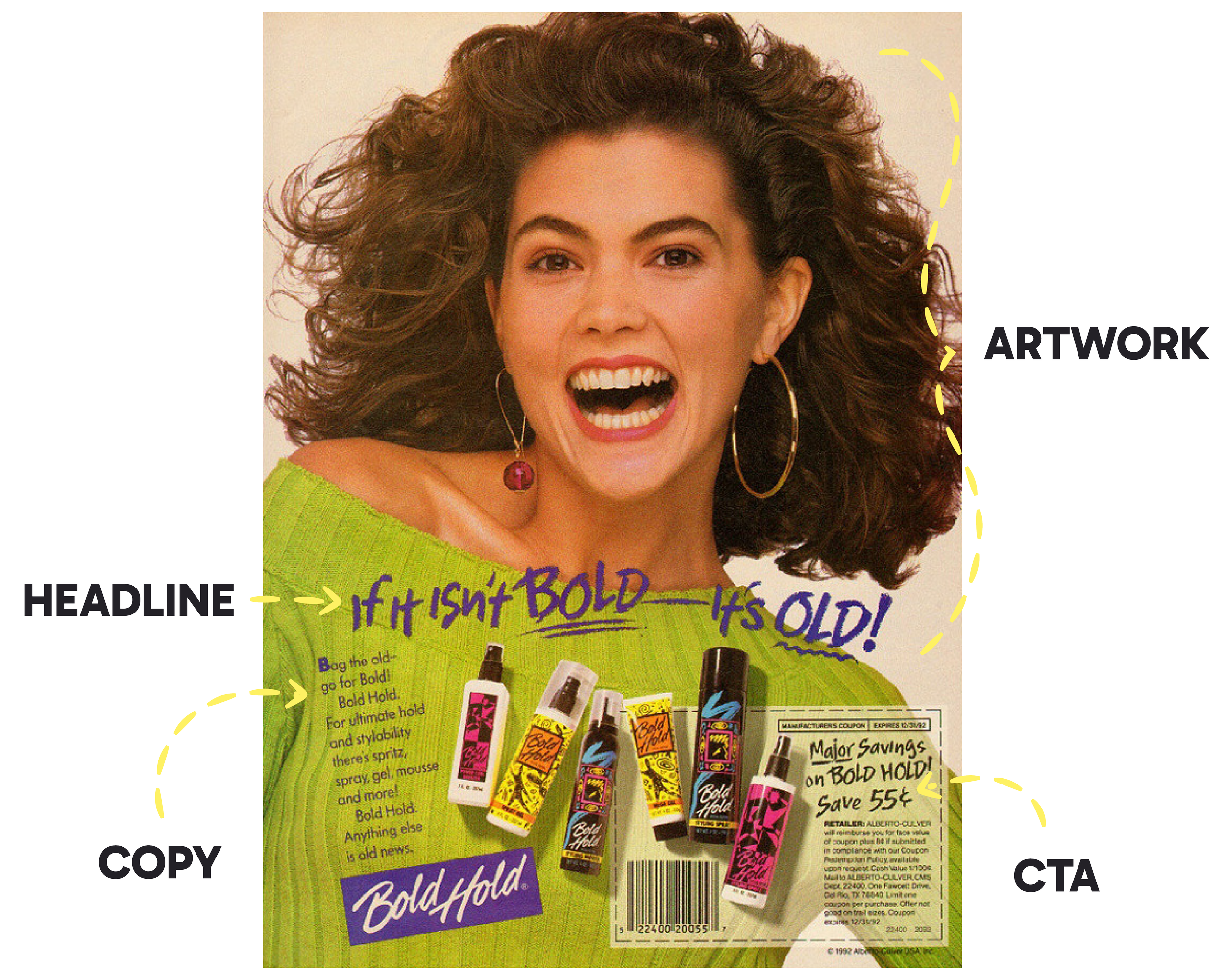
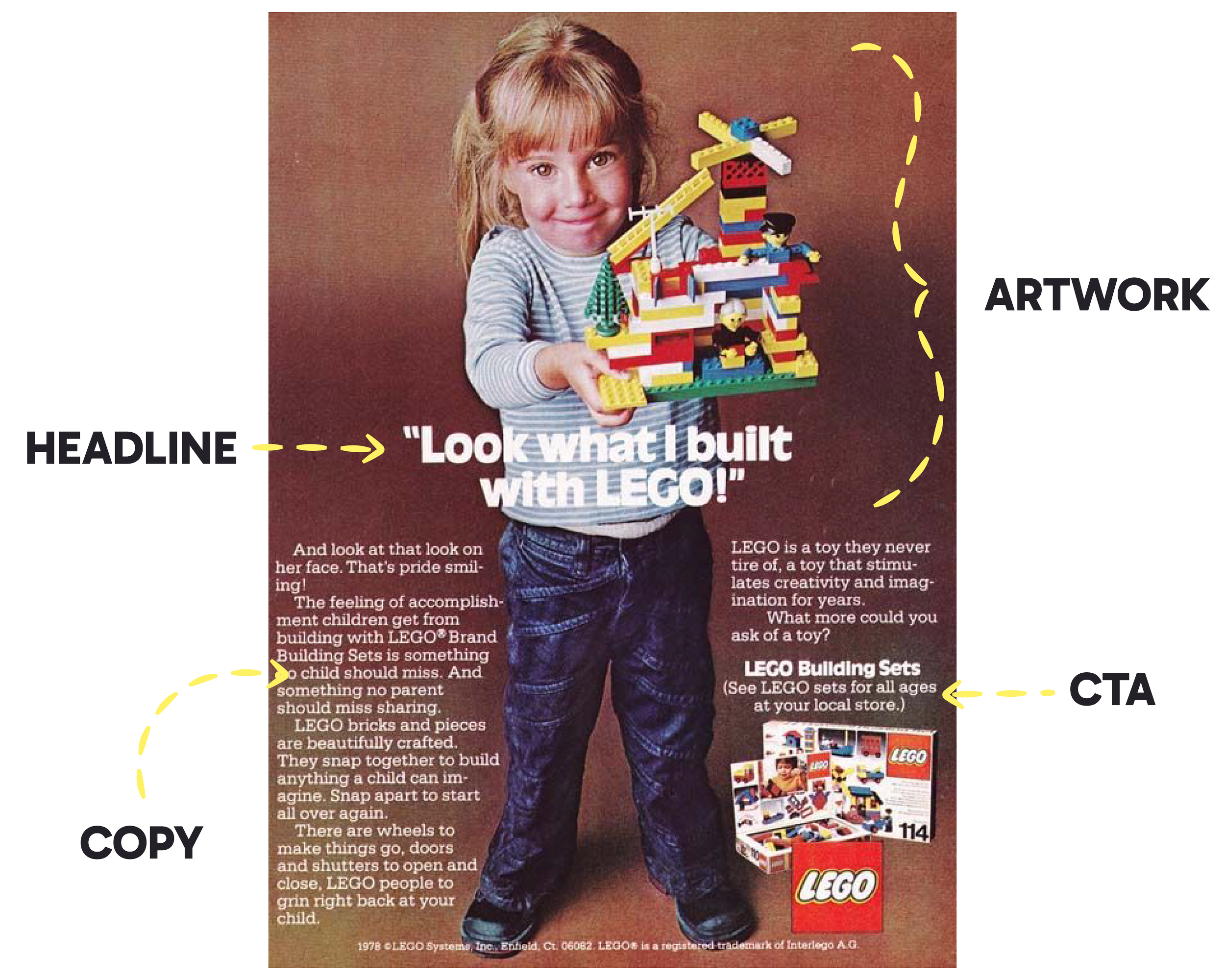
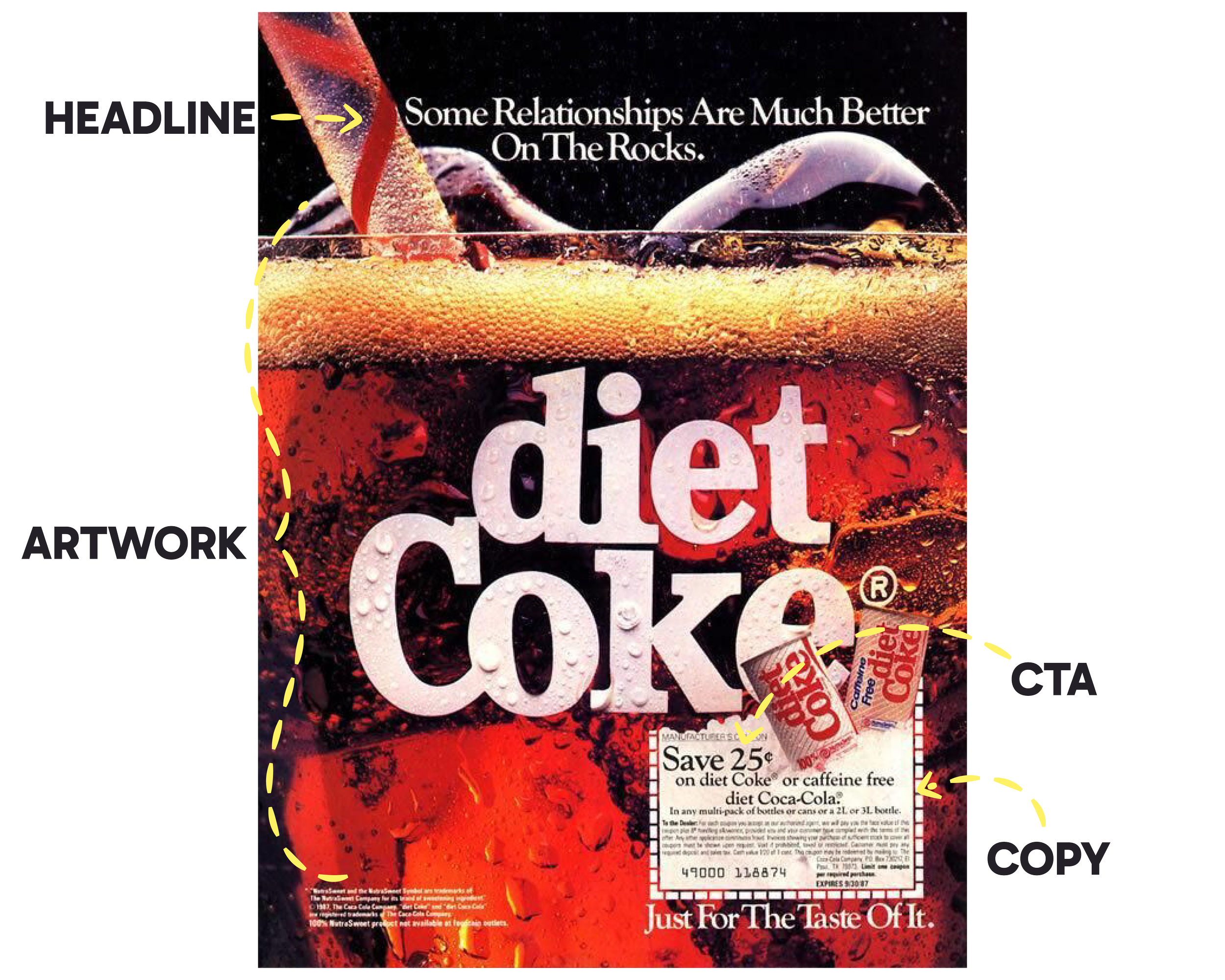
Not every advertisement has all of those elements; sometimes, advertisers are sneaky and slip in their messages. This is especially true with influencer marketing, when a brand pays a public figure to post content promoting a product. For example, Maybelline may pay a TikTok creator to make a Get Ready With Me Video featuring their new mascara. These ads are more discreet than traditional commercials and print advertisements, and they may require a close eye to detect. While parties are legally required by the Federal Trade Commission (FTC) to disclose paid partnerships in their posts, many public figures neglect to acknowledge their financial incentive in promoting products in order to seem more authentic to their audience.
Defining Target Audiences
Advertisers use many tactics to persuade target audiences to interact with a brand. A target audience is the particular group of people to which an advertisement is directed. For example, the target audience of a Huggies Diapers commercial would be parents of young babies.
Advertisers strategically cater their messaging to their target audience. First, brands research their audience to learn what they like and dislike to craft a campaign that will appeal to their audience. Researchers will conduct polls to gain insight on what an audience values to learn what motivates them to act. Then, a creative team uses that data to design a advertisement that will persuade the target audience to engage with the product. Advertisers use a variety of techniques to capture the attention and persuade their target audience, including:
Using particular colors
Using certain language
Featuring public figures
Highlighting trends
Let’s explore how advertisers create a campaign that targets a specific audience using three commercials from Superbowl LX in 2026.
Poppi, a modern probiotic soda brand, had a 30-second spot featuring popstar Charli XCX and Gen Z comedian Rachel Sennott crashing a bored college student’s lecture. In the ad, we see: 1) a college setting, 2) two celebrities that appeal to Gen Z consumers, and 3) bright light, colors, and sound. Based on these factors, we can assume Poppi’s target audience was young adult consumers in their late teens to early twenties, who may see their favorite artists enjoying the fun beverage and want to join in.
X-Finity, a communications utilities company, opted for a 60-second parody of Jurassic Park (Spielberg, 1993) with the original cast finally fetting to relax at the Jurassic Park resort thanks to X-Finity’s internet service. In this ad, we see: 1) an allusion to a movie from 1993, 2) examples of 1990s and modern technology clashing, and 3) the 1979 hit “Escape (The Piña Colada Song)” by Rupert Holmes. Based on these factors, we can assume X-Finity’s target audience is adult consumers in the 35-55 age range, who may feel nostalgic toward the creative choices made and also want to ease their ways of life with X-Finity.
Squarespace ran a 60-second spot directed by Greek auteur Yorgos Lanthimos and starring Academy Award winning actress Emma Stone to promote their website-building platform. In this ad, we see: 1) a collaboration between two current stars of the film world; 2) a cinematic, black-and-white drama; and 3) a minimal script, set, and cast. Based on these factors, we can assume Squarespace’s target audience is young creative professionals, who may enjoy the artistic production and references to classic film.