
The Hero’s Journey
THE HERO WITH A THOUSAND FACES BY JOSEPH CAMPBELL
In his 1949 seminal work The Hero with a Thousand Faces, American author and educator Joseph Campbell defined the “monomyth,” a narrative formula outlining the standard path a hero takes in mythology and folklore across global cultures (2004, p. 29). According to Campbell, the typical hero’s journey in mythology has three “rites of passage”: the separation, the initiation, and the return (2004, p. 29).
In all, Campbell argues myths have four functions: the “mystical,” which “inspires in the individual a sense of awe and gratitude in relation to the mystery dimension of the universe”; the “cosmological,” which “presents an image of the universe that links local knowledge and individual experience to that mystery dimension”; the “sociological,” which “validates, supports, and imprints on the individual the norms of that society”; and the “psychological,” which “guide[s] each individual through the stages of life, within the context of that culture” (Gerringer, n.d.). According to Campbell, “not every myth will address all four functions,” but “any mythology as a whole that fails to do so has lost its vitality” (Gerringer, n.d.). Understanding these patterns is key to understanding modern story writing.
The impact of Campbell’s The Hero with a Thousand Faces on storytelling cannot be understated; the Hero’s Journey template has been applied to countless popular characters across media. Most notably, George Lucas claims to have based Luke Skywalker’s arc in Star Wars on Campbell’s monomyth (Moyers, 1999; Seastrom, 2015; “Joseph Campbell's Mythic…”, n.d.).
Campbell’s The Hero with a Thousand Faces was written using masculine pronouns and heteronormative framing, only recognizing the patterns of male heroes in folklore. However, Campbell’s monomyth structure has since been applied to women and queer heroes, too. Popular modern examples include Katniss Everdeen from The Hunger Games (Collins, 2008), Elphaba from Wicked (Maguire, 1995), and Moana from Moana (Musker & Clements, 2016).
PHASE ONE: THE SEPARATION
Phase one of a hero’s journey in Campbell’s monomyth structure, the “separation” or the “departure,” consists of five steps.
1. The Call to Adventure
The Hero’s Journey begins with the “call to adventure,” in which destiny summons the protagonist to abandon their world of comfort for a trek into “a zone unknown” (Campbell, 2004, p. 53). Harry Potter receives his admission letter to Hogwarts and learns he is a wizard; Frodo Baggins learns he possesses the One Ring and must go on a quest to destroy it; Katniss Everdeen becomes a tribute in the Hunger Games. From this point, our hero’s life – and possibly the world at large – will never be the same. Campbell says:
“[W]hether small or great, and no matter what the stage or grade of life, the call rings up the curtain, always, on a mystery of transfiguration – a rite, or moment, of spiritual passage, which, when complete, amounts to a dying and a birth. The familiar life horizon has been outgrown; the old concepts, ideals, and emotional patterns no longer fit; the time for the passing of a threshold is at hand” (2004, p. 47).

Harry Potter receives his “call to adventure” in Harry Potter and the Sorcerer’s Stone (Columbus, 2001)
Columbus, C. (Director). (2001). Harry Potter and the Sorcerer’s Stone [Film]. Warner Bros.; Heyday Films; 1492 Pictures; Duncan Henderson Productions.
2. The Refusal of the Call
Next is the "refusal of the call,” which “converts the adventure into its negative,” and turns the hero into “a victim to be saved” (Campbell, 2004, p. 54). Simply, the hero attempts to reject their destiny, insisting the burden is too great or the hero role has been miscast.
3. Meeting the Mentor
The hero then encounters “a protective figure” who provides the hero with the tools and knowledge needed for his or her journey (Campbell, 2004, p. 63).
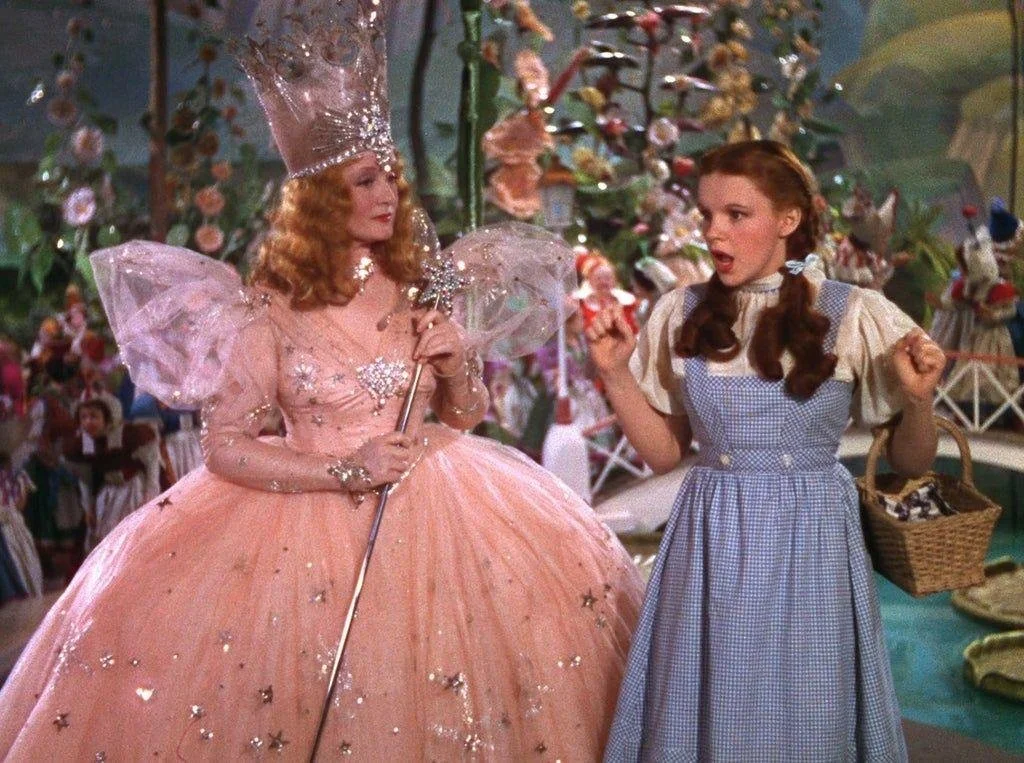
Dorothy meets her mentor, Glinda the Good Witch in The Wizard of Oz (Fleming, 1939)
Fleming, V. (Director). (1939). The Wizard of Oz [Film]. Metro-Goldwyn-Mayer.
4. The Crossing of the Threshold
Next, the hero crosses the first “threshold” to the “zone of magnified power” using “the personifications of his destiny to guide and aid him” (Campbell, 2004, p. 71). This is the point in which the hero officially leaves behind his or her world of comfort and embarks on the mystical and dangerous journey.
5. Entering the Belly of the Whale
Then, the hero enters the “belly of the whale,” in which “the hero, instead of conquering or conciliating the power of the threshold, is swallowed into the unknown, and would appear to have died” (Campbell, 2004, p. 83). This is typically where the hero faces his or her first setback in the journey, proving the hero to be fallible. According to Campbell, “this popular motif gives emphasis to the lesson that the passage of the threshold is a form of self-annihilation” (2004, p. 84).
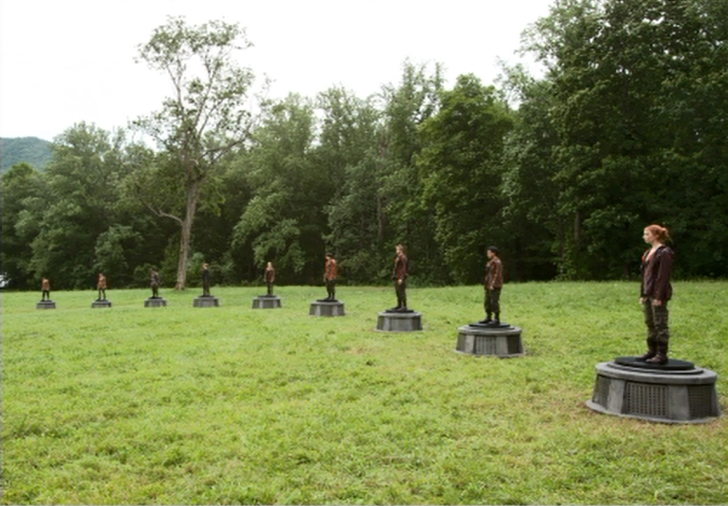
Katniss Everdeen “enters the belly of the whale” in The Hunger Games (Ross, 2012)
Ross, G. (Director). (2012). The Hunger Games [Film]. Lionsgate.
PHASE TWO: THE INITIATION
Phase two of Campbell’s Hero’s Journey, the “trials and victories of initiation,” consists of six steps.
6. The Road of Trials
In phase two of the journey, the hero embarks on the “road of trials,” in which he “moves in a dream landscape of curiously fluid, ambiguous forms” (Campbell, 2004, p. 89). Now, “the most difficult stages of the adventure now begin, when the depths of the underworld with their remarkable manifestations open before him” (Campbell, 2004, p. 91). The hero typically faces a series of three challenges to test their strength, often failing at least once, and undergo a spiritual transformation.
7. Meeting the Goddess
Then, the hero meets the “Queen Goddess of the World” who “represents the totality of what can be known” (Campbell, 2004, p. 106). The narrowness of Campbell’s heteronormativity is seen most throughout these next steps in the journey. In more inclusive interpolations of the monomyth, the “queen goddess of the world” is not necessarily a woman or romantic partner; rather, this is a figure who embodies supreme goodness and comfort that tempts the hero from his or her original path.
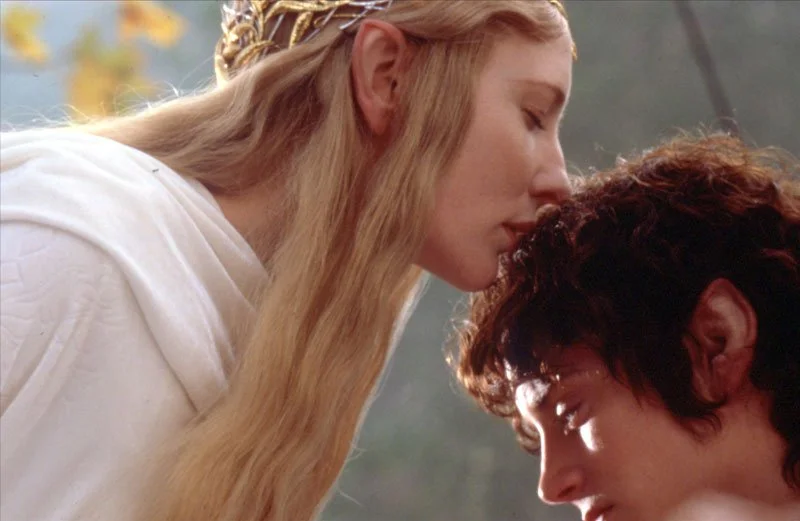
Frodo meets Lady Galadriel in The Fellowship of the Ring (Jackson, 2001)
Jackson, P. (Director). (2001). The Lord of the Rings: The Fellowship of the Ring [Film]. New Line Cinemas; WingNut Films; The Saul Zaentz Company.
8. The Mystical Marriage
Next, the hero enters a “mystical marriage” with the queen goddess (Campbell, 2004, p. 34, 111). Campbell states this action “represents the hero's total mastery of life; for the woman is life, the hero its knower and master” (2004, p. 111). Once more, this step has been expanded beyond Campbell’s initial definition; in more broad terms, the hero is simply tempted to remain with the “goddess” or caring figure rather than embark on his or her daring journey. The hero must then make the noble, selfless decision to continue the quest.
9. Atoning the Father
Taking much inspiration from the theories of Sigmund Freud, next is the hero’s “atonement with the father,” in which the hero must reject their initial worldviews and shatter their own ego (Campbell, 2004, p. 120). The “father” is less literal here, usually referring to one’s god(s) or guiding principles rather than one’s actual parent.

Luke Skywalker learns Darth Vader is his father in The Empire Strikes Back (Kershner, 1980)
Kershner, I. (Director). (1980). The Empire Strikes Back [Film]. Lucasfilm.
10. Apotheosis
Then, the hero reaches a “divine state” after going “beyond the last terrors of ignorance” (Campbell, 2004, p. 139). Campbell calls this step “apotheosis,” meaning “deification” (2004, p. 34).
11. The Ultimate Boon
Finally, the hero achieves the “ultimate boon,” or the primary goal of the journey (Campbell, 2004, p. 34). Campbell writes, “the ease with which the adventure is here accomplished signifies that the hero is a superior man, a born king” (2004, p. 159-160).

Neo becomes “The One” in The Matrix (The Wachowskis, 1999)
The Wachowskis (Directors). (1999). The Matrix [Film]. Village Roadshow Pictures; Groucho II Film Partnership; Silver Pictures.
PHASE THREE: THE REINTEGRATION
Phase three of Campbell’s Hero’s Journey, the “reintegration” or return to society, consists of six steps.
12. Refusing the Return
After achieving the ultimate boon and entering a divine state, the hero feels hesitant to return home to the “kingdom of humanity” and share his or her gifts with the world (Campbell, 2004, p. 178).
13. The Magic Flight
The hero ultimately begins his return to reality in a “magic flight,” but is often challenged by “marvels of magical obstruction and evasion” (Campbell, 2004, p. 182). The journey home can often be just as dangerous as the initial quest, as foes attempt to prevent the hero from bringing the boon to humanity.
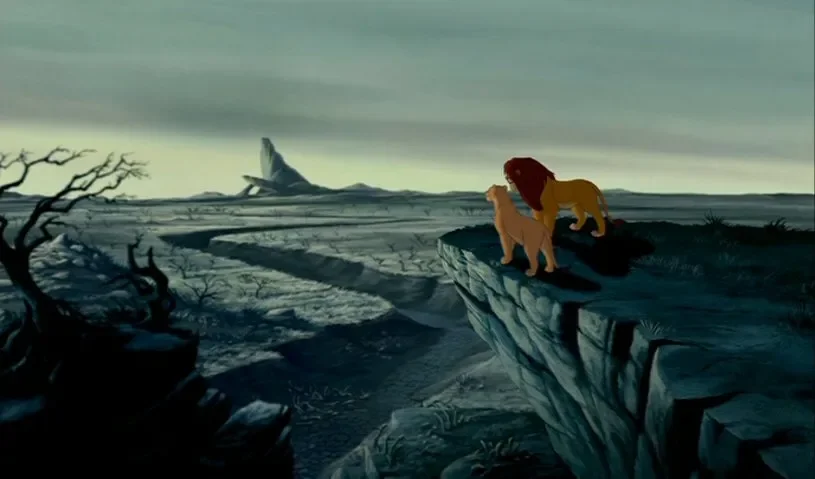
Simba returns to Pride Rock in The Lion King (Allers & Minkoff, 1994)
Allers, R. & Minkoff, R. (Directors). (1994). The Lion King [Film]. Walt Disney Feature Animation.
14. Assistance from a Magical Force
In order to get home, the hero is rescued “from his supernatural adventure by assistance from without,” calling upon guides, mentors, and aides from earlier in his or her journey (Campbell, 2004, p. 192). Campbell writes, “[myths] show in the final stages of the adventure the continued operation of the supernatural assisting force that has been attending the elect through the whole course of his ordeal” (2004, p. 201).
15. Crossing the Return Threshold
Next is the “crossing of the return threshold,” in which the hero “come[s] back out of that yonder zone” that is the divine realm and reintegrates with society (Campbell, 2004, p. 34, 201). According to Campbell, “the first problem of the returning hero is to accept as real, after an experience of the soul-satisfying vision of fulfillment, the passing joys and sorrows, banalities and noisy obscenities of life” (2004, p. 202).

Frodo returns to the Shire, feeling disillusioned
Jackson, P. (Director). (2003). The Lord of the Rings: The Return of the King [Film]. New Line Cinema; WingNut Films.
16. Mastering the Two Worlds
Then, the hero becomes the “master of the two worlds” (Campbell, 2004, p. 34). Now, the hero has the “freedom to pass back and forth across the world division… not contaminating the principles of the one with those of the other, yet permitting the mind to know the one by virtue of the other” (Campbell, 2004, p. 213).
17. Achieving Inner Peace
Finally, the hero achieves inner peace and has the “freedom to live” (Campbell, 2004, p. 34). In this stage, “the hero comes back from this mysterious adventure with the power to bestow boons on his fellow man” (Campbell, 2004, p. 29).

Katniss and Peeta live a pastoral life at the end of The Hunger Games series
Lawrence, F. (Director). (2015). The Hunger Games: Mockingjay – Part 2 [Film]. Lionsgate & Color Force.