
The Characters of The Addams Family
Morticia Addams
Morticia Addams was the first member of the Addams Family created by Charles Addams, making her New Yorker debut on August 6, 1938 (p. 9). Addams described Morticia as “the real head of the family and the critical and moving force behind it” (Miserocchi, 2010). Morticia is “low-voiced, incisive, and subtle,” rarely smiling and avoiding cliches (Miserocchi, 2010, p. 44). She has long, sleek, dark hair and wears a seductive black form-fitting gown with a tattered tentacle train – a “glamorous femme fatale” (Miserocchi, 2010, p. 44). Her name is a variation of the word “mortician.”
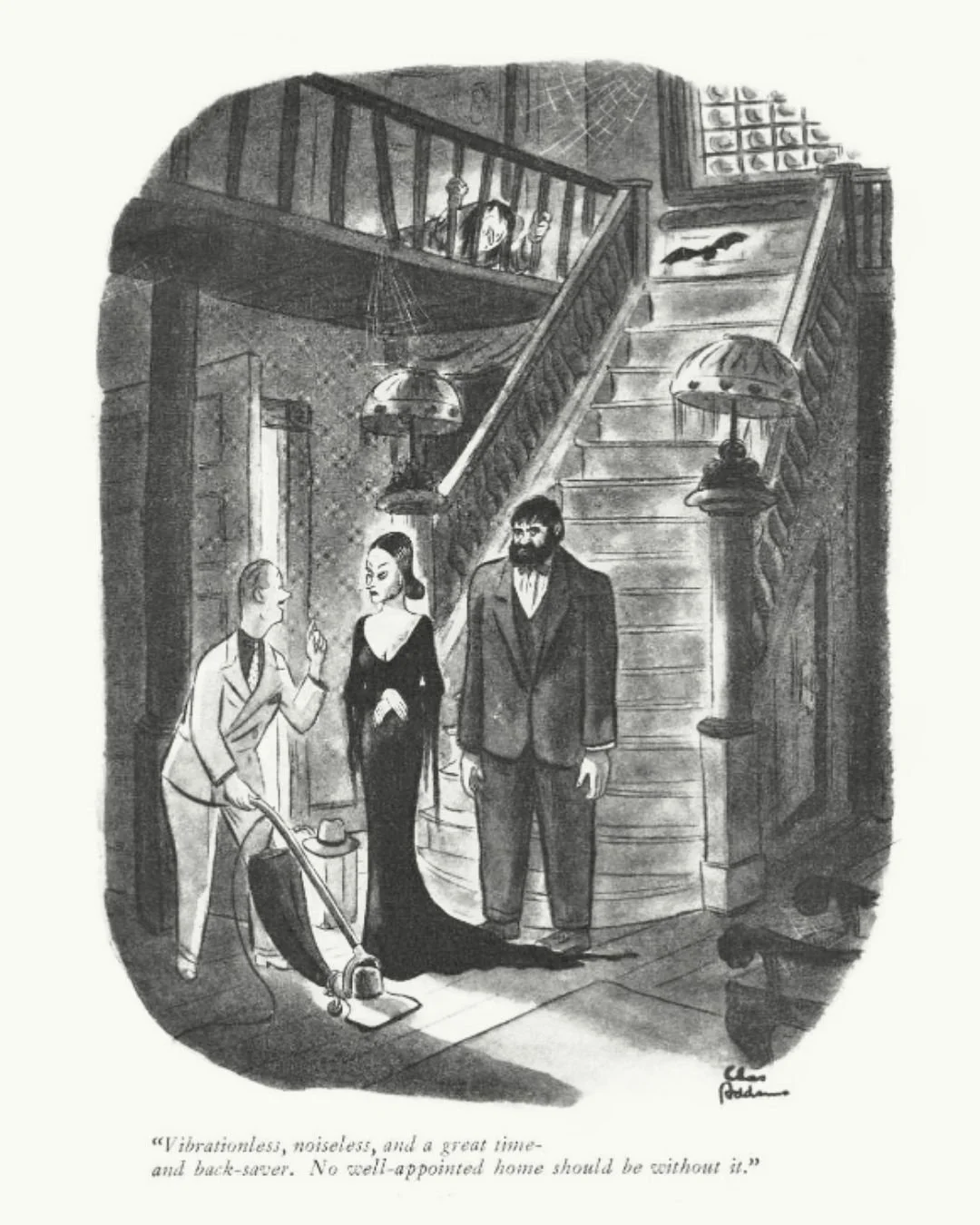
Addams, C. (1938, Aug. 6). “Vibrationless, Noiseless, and a great time…” [Illustration]. The New Yorker, p. 9. https://archives.newyorker.com/newyorker/1938-08-06/flipbook/8/.
MORTICIA’S MUSICAL MOTIFS
To create the character of Morticia Addams in The Addams Family Broadway musical, Andrew Lippa explored Eastern European folk music, borrowing from their emphasis on strings. Morticia's musical motifs evoke Romani and flamenco sounds, blending her Eastern European background with Gomez's Latin heritage. Lippa also parodies traditional musical theatre throughout the show's lyrics and score; Morticia's solo "Death Is Just Around the Corner" inverts the classic optimistic musical theatre song "Put On a Happy Face" from Singin' in the Rain (Kelly & Donen, 1952).
Morticia Addams’s Playlist
Recommended listening and viewing to get into character for the musical adaptation of The Addams Family.
▶︎ “Niška banja” by Olivera Vučo
▶︎ Traditional Russian Gypsy song entitled “Two Guitars”
▶︎ “Krivo Sadovsko Horo” by the Barcelona Gipsy BalKan Orchestra
▶︎ “Monti Csárdás (Czardas)” performed by the Szalai Hungarian Gypsy Band
NEW YORKER CARTOONS FEATURING MORTICIA ADDAMS
-
![]()
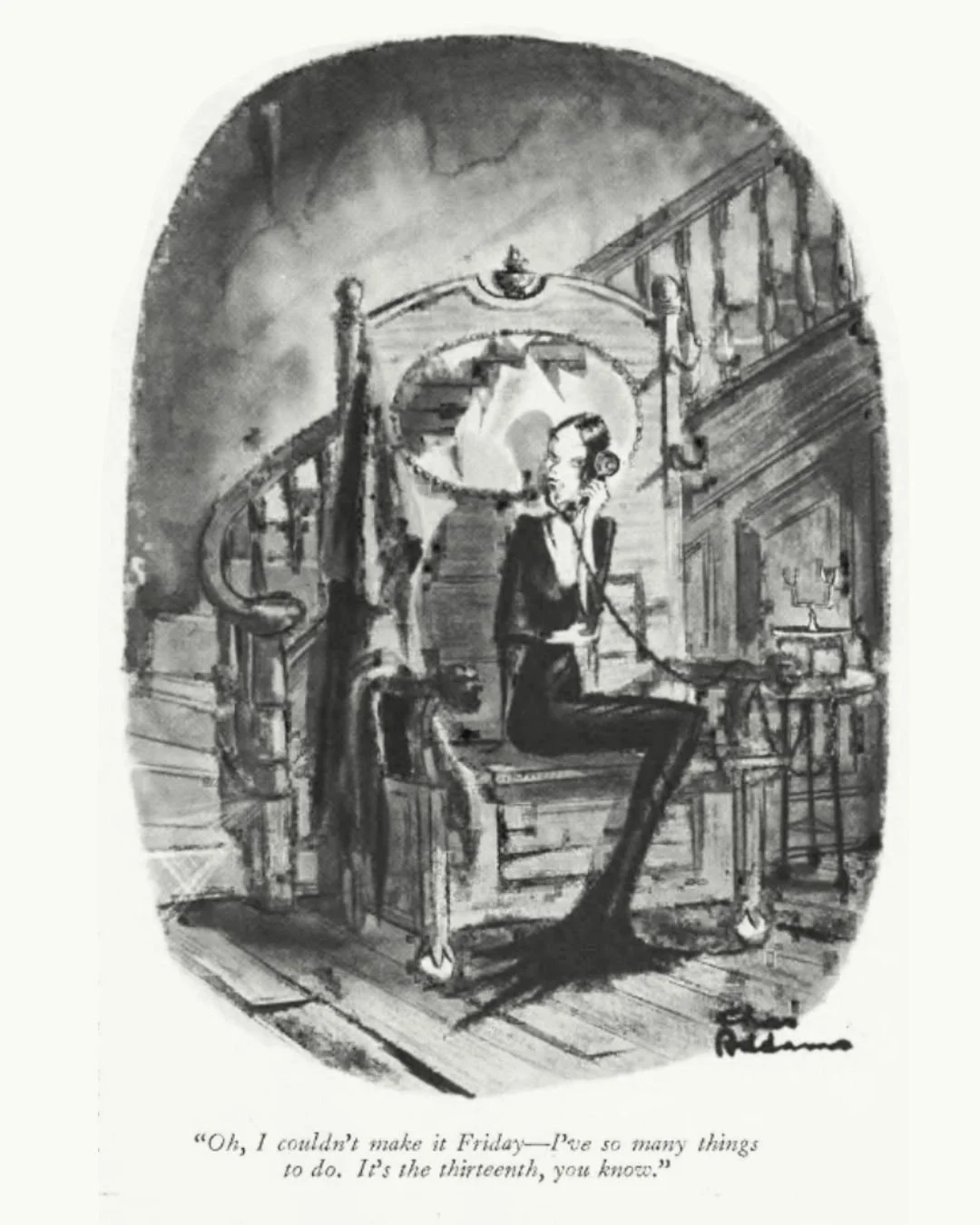
Addams, C. (1945, Apr. 14). “Oh, I couldn’t make it Friday…” [Illustration]. The New Yorker, p. 23. https://archives.newyorker.com/newyorker/1945-04-14/flipbook/022/.
-
![]()
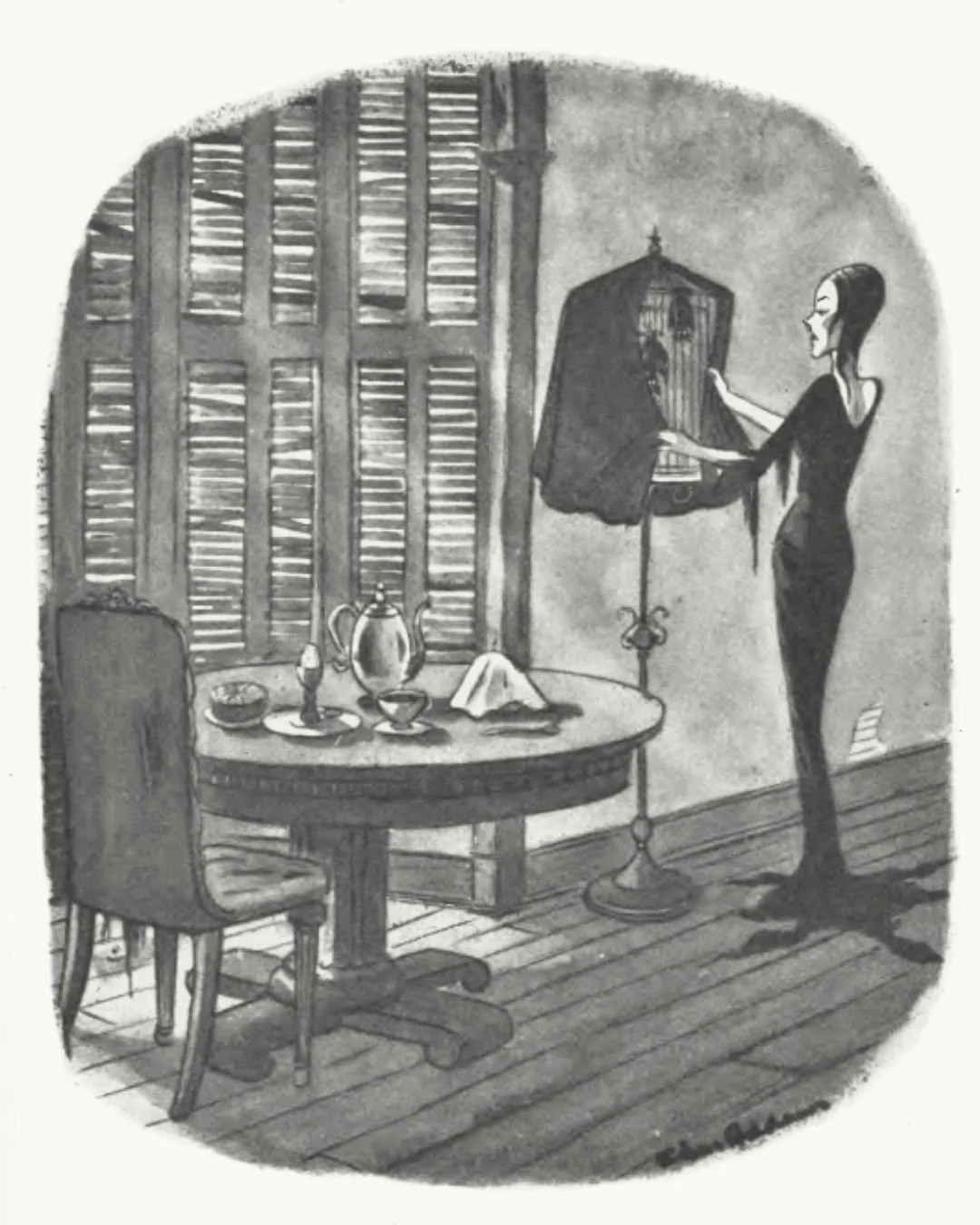
Addams, C. (1952, Feb. 9). “Morticia with Batcage” [Illustration]. The New Yorker, p. 40. https://archives.newyorker.com/newyorker/1952-02-09/flipbook/040/.
-
![]()
Addams, C. (1956, Jan. 28). “We won’t be late, Miss Weems” [Illustration]. The New Yorker, p. 27. https://archives.newyorker.com/newyorker/1956-01-28/flipbook/026/.

Gomez Addams
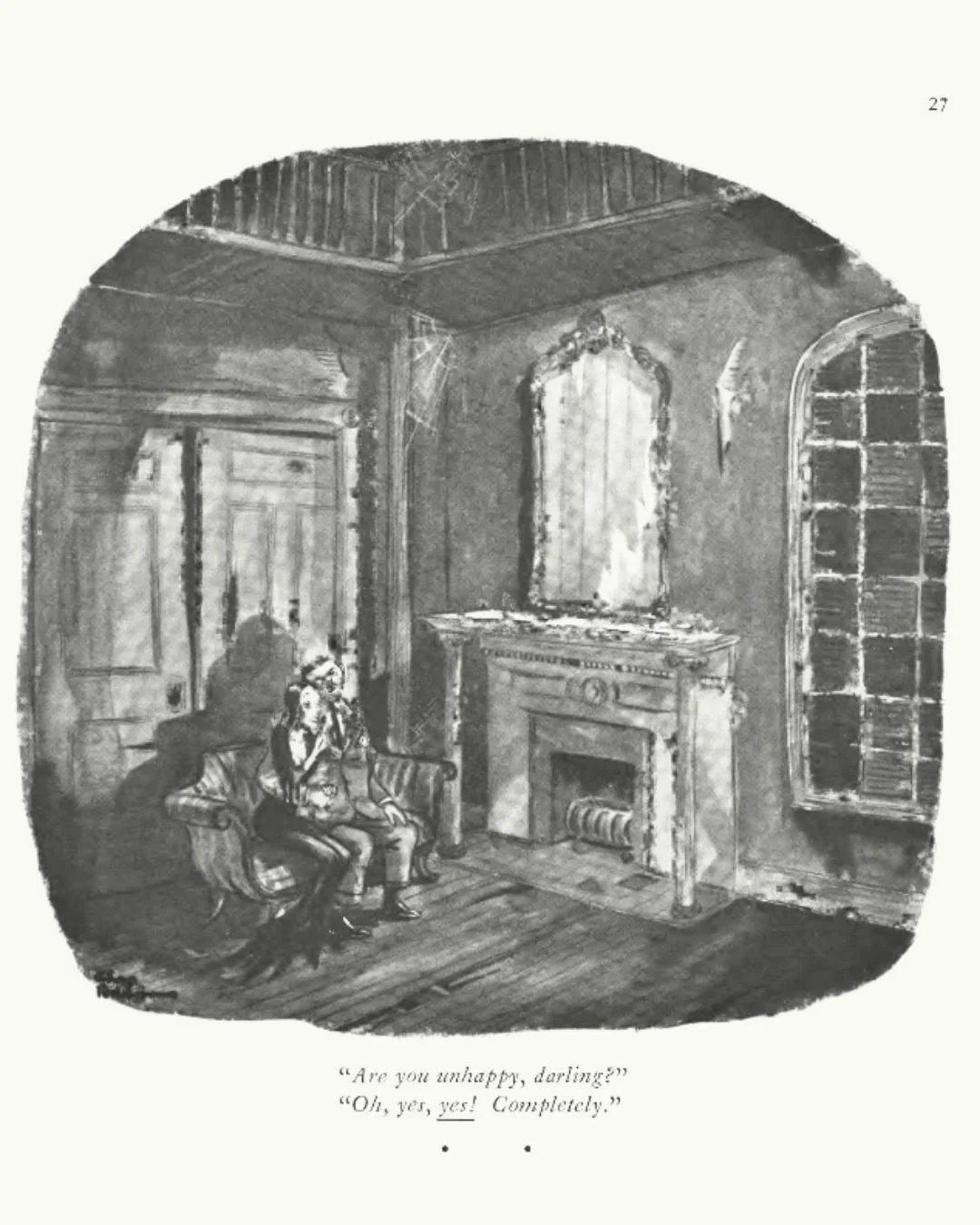
Gomez Addams first appeared in The New Yorker on November 14, 1942, in a comic with his beloved wife, Morticia. In the illustration, Gomez asks Morticia, “Are you unhappy, dear?” to which she replies, “Oh yes, yes! Completely!” (Addams, 1942, p. 27). According to creator Charles Addams, Gomez is “a crafty schemer” and “jolly man” who “tries hard to be father and teacher to the children, though sometimes misguided” (Miserocchi, 2010, p. 62). He is “sentimental and often puckish,” relying on Morticia to “straighten him out” (Miserocchi, 2010, p. 62). Gomez’s devotion to both his wife and his children comes into conflict in the stage version of The Addams Family. In the stage show, Gomez must keep Wednesday’s engagement a secret from Morticia, betraying her trust in the process.
Gomez has “a lot more money than wit or brains” and is usually seen in a double-breasted pinstripe suit (Miserocchi, 2010, p. 62). Despite his name, Gomez’s Latin descent was not confirmed as canon until the 1991 live-action film directed by Barry Sonnenfeld. His Latino heritage has been affirmed in every subsequent adaptation.
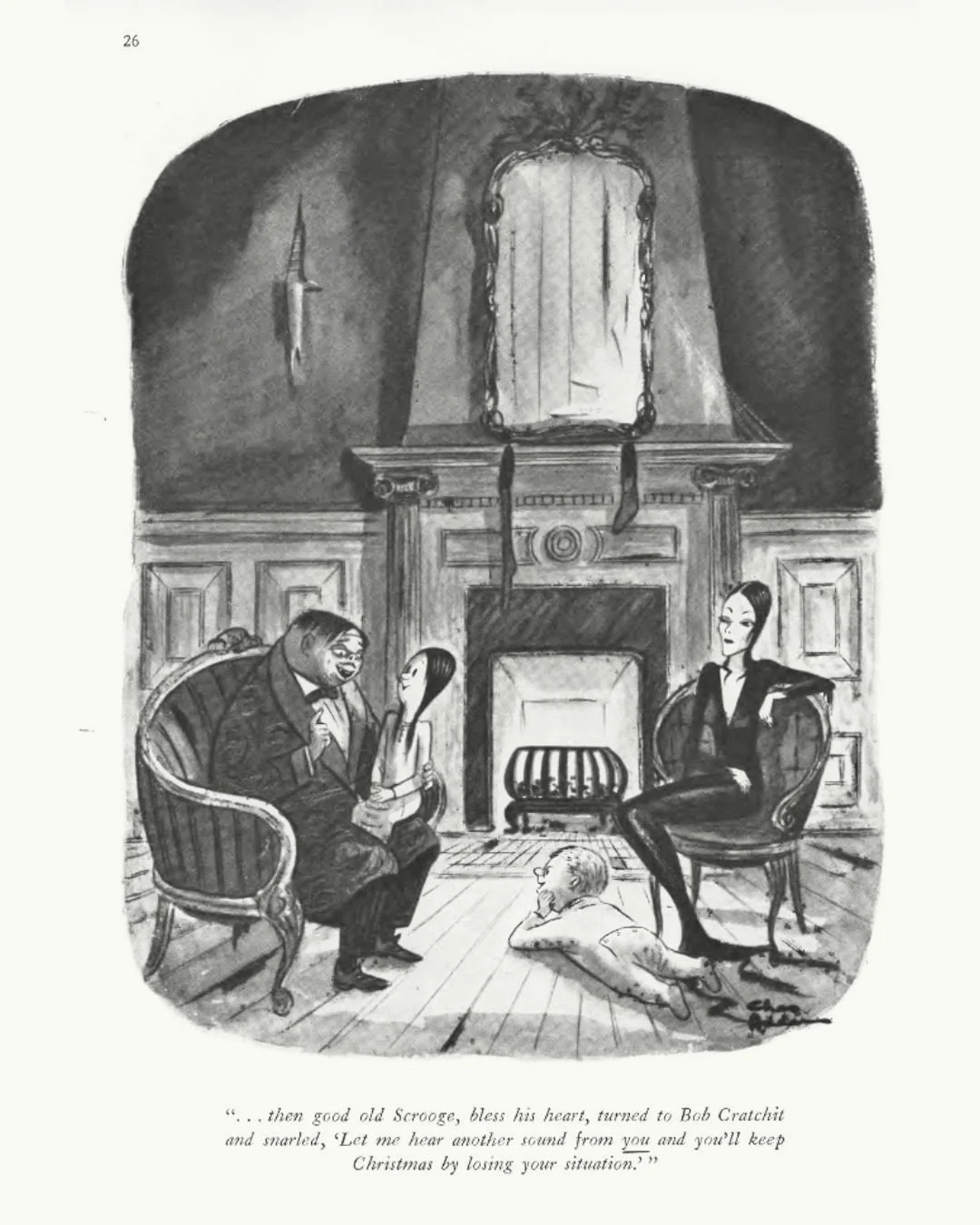
Addams, C. (1950, Dec. 30). “...then good old Scrooge…” [Illustration]. The New Yorker, p. 26. https://archives.newyorker.com/newyorker/1950-12-23/flipbook/026/.
GOMEZ’S MUSICAL MOTIFS
Composer Andrew Lippa uses Latin guitars and flamenco sounds to represent the romantic Addams patriarch. Like Morticia, Gomez has the opportunity to parody classic musical theatre; his song "Morticia" in the first act is a play on "Maria" from West Side Story (Bernstein & Sondheim, 1957).
Gomez Addams’s Playlist
Recommended listening and viewing to get into character for the musical adaptation of The Addams Family.
▶︎ Sabicas performs “Fantasia”
▶︎ Besame Mucho by Trio Los Panchos
▶︎ “La Llorona” by Chavela Vargas
NEW YORKER CARTOONS FEATURING GOMEZ ADDAMS
-
![]()
Addams, C. (1942, Nov. 14). “Are you unhappy, darling?” [Illustration]. The New Yorker, p. 27. https://archives.newyorker.com/newyorker/1942-11-14/flipbook/026/.
-
![]()
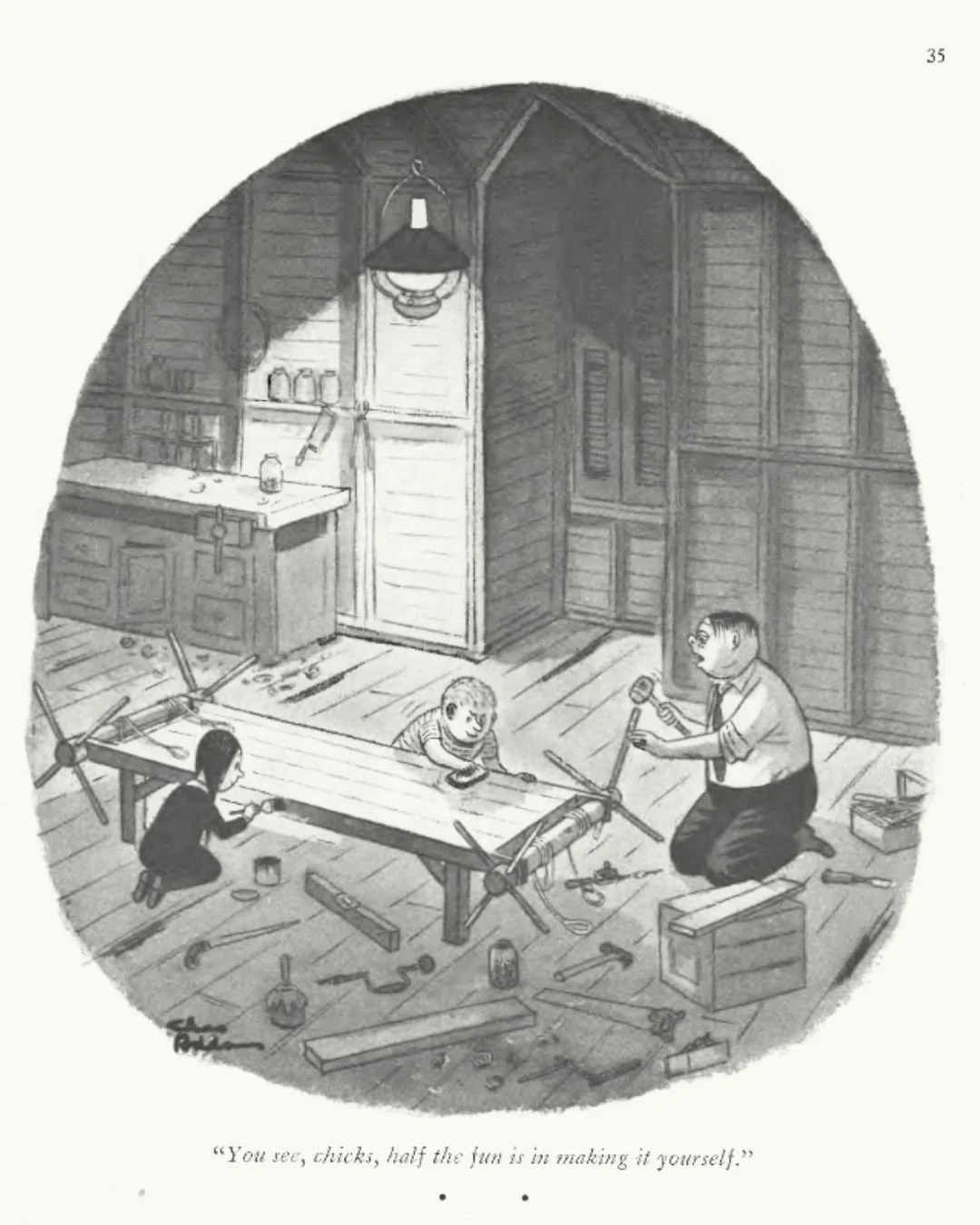
Addams, C. (1950, May 27). “You see, chicks…” [Illustration]. The New Yorker, p. 35. https://archives.newyorker.com/newyorker/1950-05-27/flipbook/034/.
-
![]()
Addams, C. (1952, Mar. 1). “Just the kind of day that makes you feel good to be alive!” [Illustration]. The New Yorker, p. 31. https://archives.newyorker.com/newyorker/1952-03-01/flipbook/030/.

Wednesday Addams
Named for the 19th-century nursery rhyme “Monday’s Child,” Wednesday Addams is “full with woe” (Halliwell-Phillipps, J.O., 1849, p. 228). Charles Addams said the young Addams daughter is “a solemn child, prim in dress and, on the whole, pretty lost” (Miserocchi, 2010, p. 80). She is mysterious and imaginative, though prone to the occasional tantrum in the comics. According to Addams, Gomez has a secret soft spot for his daughter – a trait that was carried into the stage musical as Gomez struggles to accept his little girl is growing up (Miserocchi, 2010, p. 80).
The Addams Family musical adaptation deviates from all its predecessors by aging up Wednesday to 18 years old, creating new tensions within the Addams family dynamic as she establishes her independence. In The Addams Family, Wednesday experiences feelings of joy for the first time – an extreme oddity for the emotionless Addams daughter – after meeting a boy named Lucas Beineke in Central Park and falling in love. In the show, she finds herself stuck between her family’s traditions and starting a new life with Lucas. Ultimately, she must find a way to reconcile these two families to create one for herself.
“Monday’s Child” poem from which Wednesday gets her name
Halliwell-Phillipps, J.O.(1849). “DAYS OF BIRTH.” In Popular Rhymes and Nursery Tales: A Sequel to the Nursery Rhymes of England. J.R. Smith, London, U.K. p. 228.
THE TEENAGE 2000s
The decision to make Wednesday a teenager also reflects a larger rise of young adult (YA) media in the 2000s. Riding off of the popularity of the boy bands and teen dramas in the 1990s, the early 2000s brought upon a new wave of youth-centric franchises and the cementing of the teen market. During this time, YA books dominated the literature market and inspired countless book-to-screen adaptations, most notably the Harry Potter franchise by J.K. Rowling, the Twilight series by Stephenie Meyer, and the The Hunger Games trilogy by Suzanne Collins. In television, The WB, Disney Channel, and Nickelodeon transformed their programming to produce an array of shows for teens, starring teens, including hits like Gilmore Girls (Sherman-Palladino & Palladino, 2000-2007), One Tree Hill (Schwahn, 2000-2007), Lizzie McGuire (Rogow, 2001-2004), That’s So Raven (Poryes, 2003-2007), Hannah Montana (Peterman & Poryes, 2006-2011), Drake and Josh (Schneider, 2004-2007), and Zoey 101 (Schneider, 2005-2008). Meanwhile, teen idols Britney Spears, *NSYNC, Christina Aguilera, Mandy Moore, Taylor Swift, and Justin Bieber dominated the pop music charts (Greene, 2012; Rosa, 2016). Vanity Fair highlighted this teen phenomena in their July 2003 issue “It’s Totally Raining Teens,” with a cover story by James Wolcott and a infamously contentious photoshoot by Mark Seliger (Walsh, 2023).
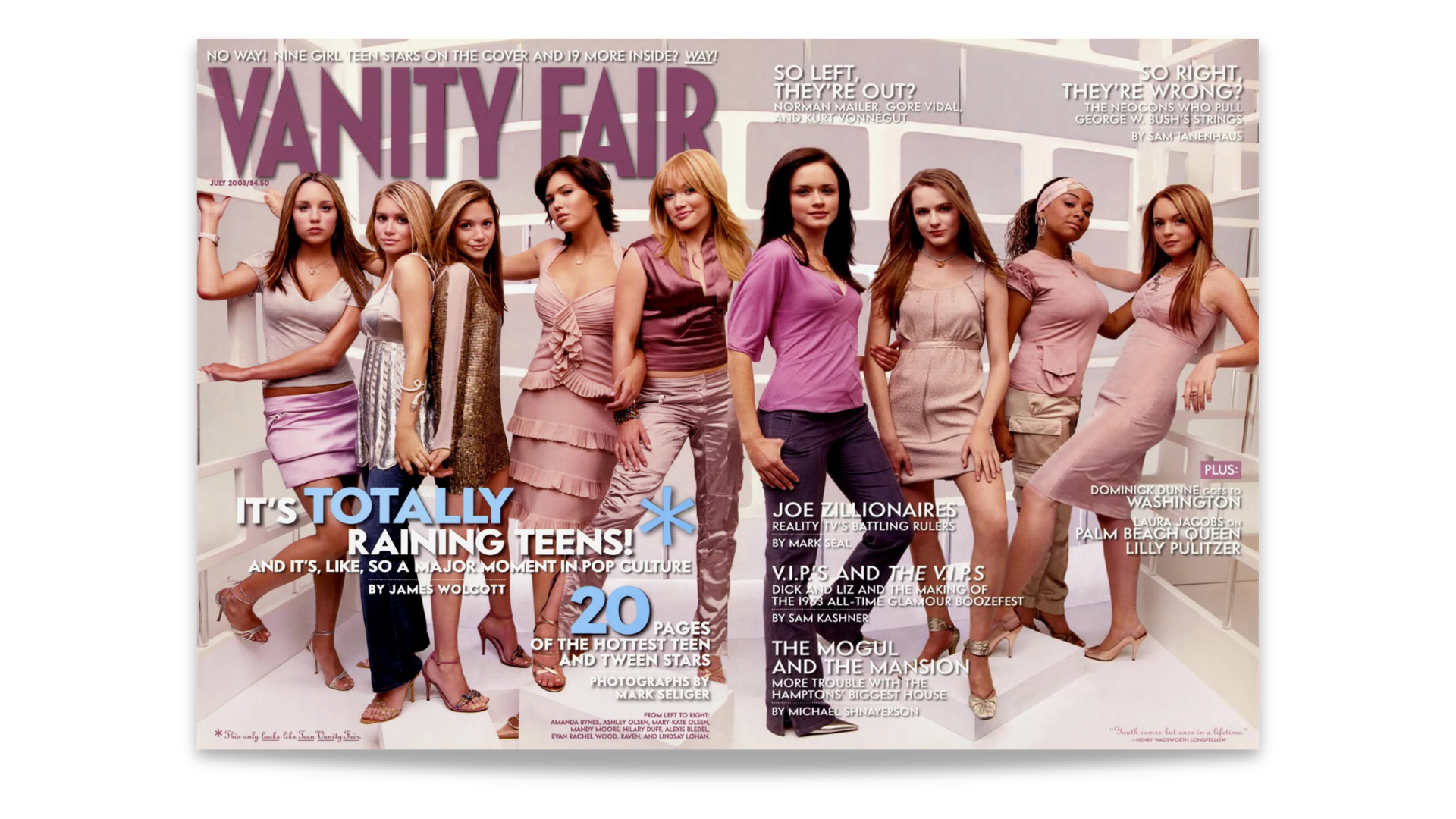
Vanity Fair’s “It’s Raining Teens” 2003 cover story
Wolcott, J. (2003, July). “It’s Raining Teens.” Vanity Fair.
WEDNESDAY’S MUSICAL MOTIFS
Wednesday Addams has a contemporary pop punk theme, representing the youth culture of the time. Wednesday's songs feature energetic electric guitars, contrasting the acoustic flamenco strumming found in her parents' songs. However, she does share her parents' affinity for parody. In "Pulled," Lippa spoofs the Disney princess "animal whisperer" trope — instead of singing daintily with a little bird, Wednesday accidentally kills one.
Wednesday Addams’s Playlist
Recommended listening and viewing to get into character for the musical adaptation of The Addams Family.
▶︎ “Welcome To The Black Parade” by My Chemical Romance
▶︎ “Bring Me To Life” by Evanescence
▶︎ “Sk8er Boi” by Avril Lavigne
▶︎ “The Only Exception” by Paramore
▶︎ Scene of Snow White singing with animals in the forest in Snow White (1939)
NEW YORKER CARTOONS FEATURING WEDNESDAY ADDAMS
-
![]()
Addams, C. (1944, Aug. 26). “Well, don't come whining…” [Illustration]. The New Yorker, p. 29. https://archives.newyorker.com/newyorker/1944-08-26/flipbook/028/.
-
![]()
Addams, C. (1954, June 26). “Gomez pushing Wednesday on a broomstick swing” [Illustration]. The New Yorker, p. 23. https://archives.newyorker.com/newyorker/1954-06-26/flipbook/022/.
-
![]()
Addams, C. (1954, Oct. 16). “Oh, she’s furious because they put her on the honor roll at school” [Illustration]. The New Yorker, p. 25. https://archives.newyorker.com/newyorker/1954-10-16/flipbook/024/.
-
![]()
Addams, C. (1954, Nov. 6). “Wednesday with a loose tooth” [Illustration]. The New Yorker, p. 36. https://archives.newyorker.com/newyorker/1954-11-06/flipbook/036/.


Pugsley Addams
Charles Addams described Pugsley Addams as “an energetic monster of a boy about nine years old – blondish red hair, popped blue eyes and a dedicated troublemaker – in other words, the kid next door” (Miserocchi, 2010, p. 80). His favorite pastimes include building his own guillotines, poisoning his younger sister, and pranking bystanders with the Addams’s unusual pets (Miserocchi, 2010, p. 80). When illustrating the child, Addams had always called him “Pubert” (Miserocchi, 2010, p. 81). However, ABC wouldn’t approve of the name when adapting the Family for television, so Addams decided on “Pugsley” – after the Pugsley Creek in the Bronx – instead (Miserocchi, 2010, p. 81).
In the original comics, Pugsley Addams is the eldest child of the Addams Family, though The Addams Family stage musical changed his role to younger brother. Though the musical does maintain Pugsley’s impish nature, this time directing his mischief toward thwarting his sister’s engagement so that she remains at home with him.
NEW YORKER CARTOONS FEATURING PUGSLEY ADDAMS
-
![]()
Addams, C. (1948, Aug. 14). “Now kick Daddy good night and run along to bed” [Illustration]. The New Yorker, p. 31. https://archives.newyorker.com/newyorker/1948-08-14/flipbook/030/.
-
![]()
Addams, C. (1949, Dec. 24). “Wednesday and Pugsley on Christmas Day” [Illustration]. The New Yorker, p. 27. https://archives.newyorker.com/newyorker/1949-12-24/flipbook/026/.
-
![]()
Addams, C. (1951, June 9). “All right, children, a nice big sneer, now” [Illustration]. The New Yorker, p. 37. https://archives.newyorker.com/newyorker/1951-06-09/flipbook/036/.
-
![]()
Addams, C. (1945, Nov. 3). “Well, he certainly doesn’t take after my side of the family” [Illustration]. The New Yorker, p. 31. https://archives.newyorker.com/newyorker/1945-11-03/flipbook/030/.


Lurch
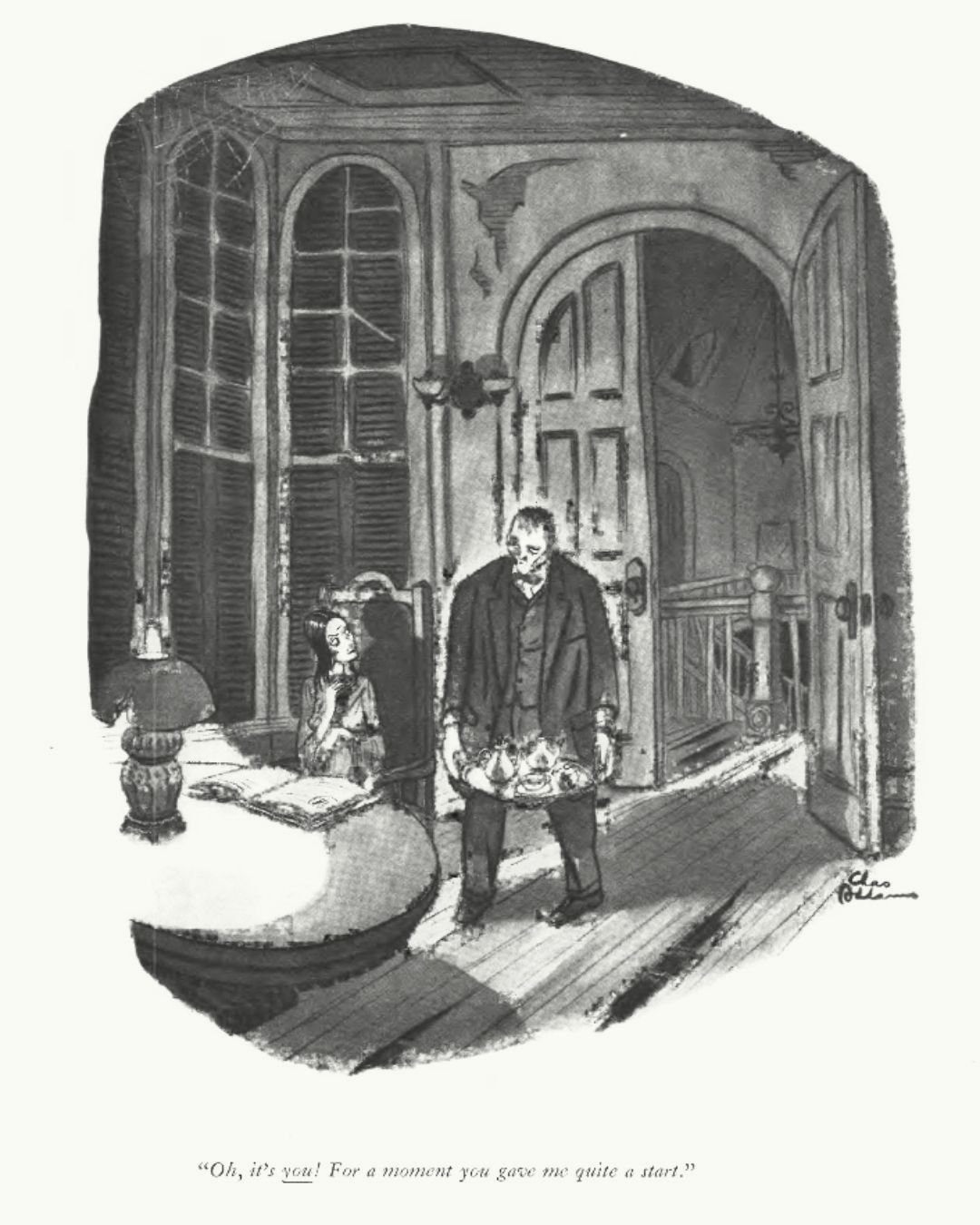
Lurch is the lumbering, silent butler of the Addams Family. Of Lurch, Charles Addams said, “this towering mute has been shambling around the house forever” (Miserocchi, 2010, p. 118). While his character design favors Frankenstein’s monster, Lurch is not a monster of any sort; he adores the Addams children and faithfully dotes on the family, though not skillfully. He is “slow-witted but truly kind,” and until the television adaptation, Charles Addams had never even considered his appearance would be frightening to anyone (Miserocchi, 2010, p. 120).
NEW YORKER CARTOONS FEATURING LURCH
-
![]()
Addams, C. (1939, Nov. 25). “Oh, it’s you! For a moment you gave me quite a start” [Illustration]. The New Yorker, p. 16. https://archives.newyorker.com/newyorker/1939-11-25/flipbook/016/.
-
![]()
Addams, C. (1947, Aug. 30). “It's the children darling - back from camp” [Illustration]. The New Yorker, p. 21. https://archives.newyorker.com/newyorker/1947-08-30/flipbook/020/.
-
![]()
Addams, C. (1951, Sept. 29). “Lurch takes Pugsley to the schoolbus” [Illustration]. The New Yorker, p. 31. https://archives.newyorker.com/newyorker/1951-09-29/flipbook/030//.
-
![]()
Addams, C. (1952, Nov. 22). “You forgot the eye of newt” [Illustration]. The New Yorker, p. 45. https://archives.newyorker.com/newyorker/1952-11-22/flipbook/044/.


Uncle Fester
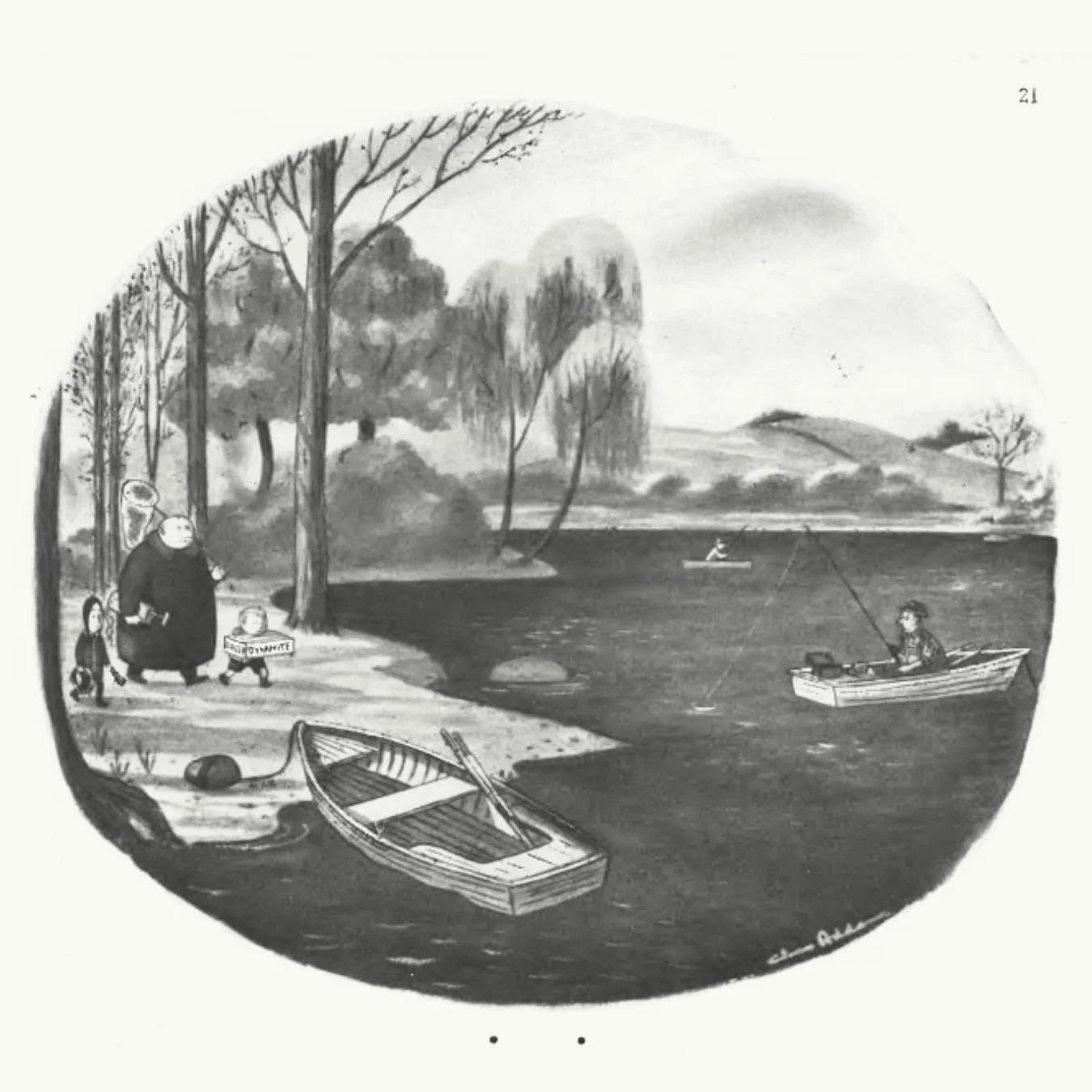
Charles Addams called Uncle Fester an “incorrigible” fellow, who “except for the good nature of the family and the ignorance of the police, would ordinarily be under lock and key” (Miserocchi, 2010, p. 146). Despite this, Addams stated the character he related to most was, in fact, Uncle Fester (Miserocchi, 2010, p. 147). Uncle Fester’s favorite pastimes include fishing with dynamite, watching grotesque cinema, and playing with electricity (Miserocchi, 2010, p. 146-7).
Uncle Fester serves as the narrator in the musical The Addams Family, providing asides and musical interludes for the audience. In the show, Uncle Fester is in love with the moon and hopes everyone else can find that same undying devotion. This leads Fester to interfere with the family’s ancestral ceremony and pull the strings needed for Wednesday to be with Lucas.

Addams, C. (1973, Feb. 17). “Fester with his electronics” [Illustration]. The New Yorker, p. 41. https://archives.newyorker.com/newyorker/1973-02-17/flipbook/040/.
UNCLE FESTER’S MUSICAL MOTIFS
Composer Andrew Lippa took inspiration from early 20th century vaudeville when writing music for Uncle Fester. His musical motifs are lighter than the rest of the family, with delicate plucky piano techniques and soft ukulele strumming. Fester, too, directly parodies iconic musical performances in film history. His solo "The Moon and Me" begins with a simple ukulele ode to the moon that evokes Audrey Hepburn performing "Moon River" in Breakfast at Tiffany's (Edwards, 1961), and concludes with an interpolation of Debussy’s “Clair de Lune” (1905).
Uncle Fester’s Playlist
Recommended listening and viewing to get into character for the musical adaptation of The Addams Family.
▶︎ “Happy Days Are Here Again” by Phil Lynch
▶︎ “By The Light Of The Silvery Moon” by Ray Noble
▶︎ “Living In the Sunlight” by Tiny Tim
NEW YORKER CARTOONS FEATURING FESTER
-
![]()
Addams, C. (1946, Mar. 23). “Fester at the cinema” [Illustration]. The New Yorker, p. 31. https://archives.newyorker.com/newyorker/1946-03-23/flipbook/030/.
-
![]()
Addams, C. (1950, Feb. 11). “Fester Dreaming of Sheep” [Illustration]. The New Yorker, p. 27. https://archives.newyorker.com/newyorker/1950-02-11/flipbook/026/.
-
![]()
Addams, C. (1953, Sept. 19). “Fester and the children visit the lake” [Illustration]. The New Yorker, p. 21. https://archives.newyorker.com/newyorker/1953-09-19/flipbook/020/.
-
![]()
Addams, C. (1964, July 18). “Fester visits North Haven Marina” [Illustration]. The New Yorker, p. 31. https://archives.newyorker.com/newyorker/1964-07-18/flipbook/030/.



Grandma Frump, or Grandmama
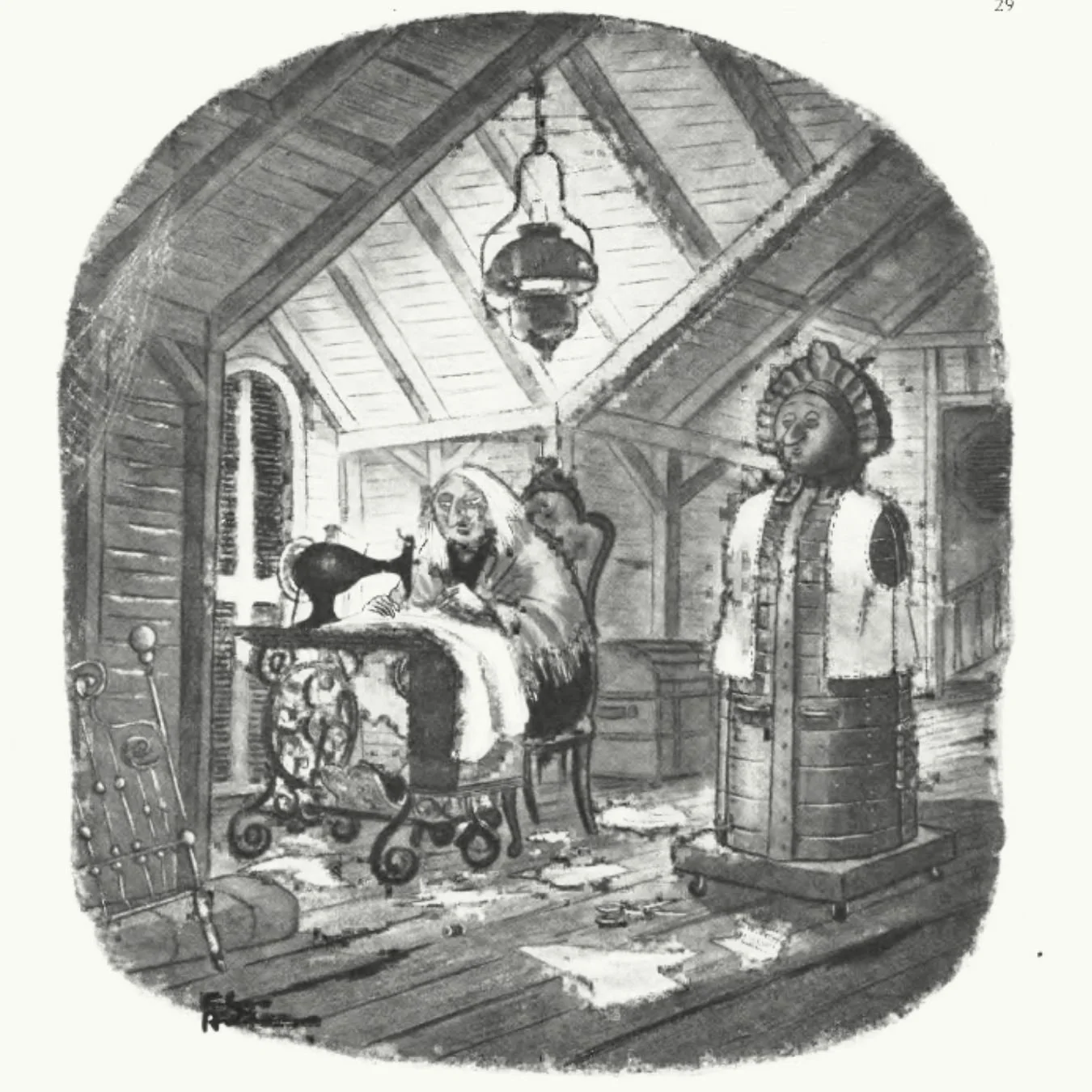
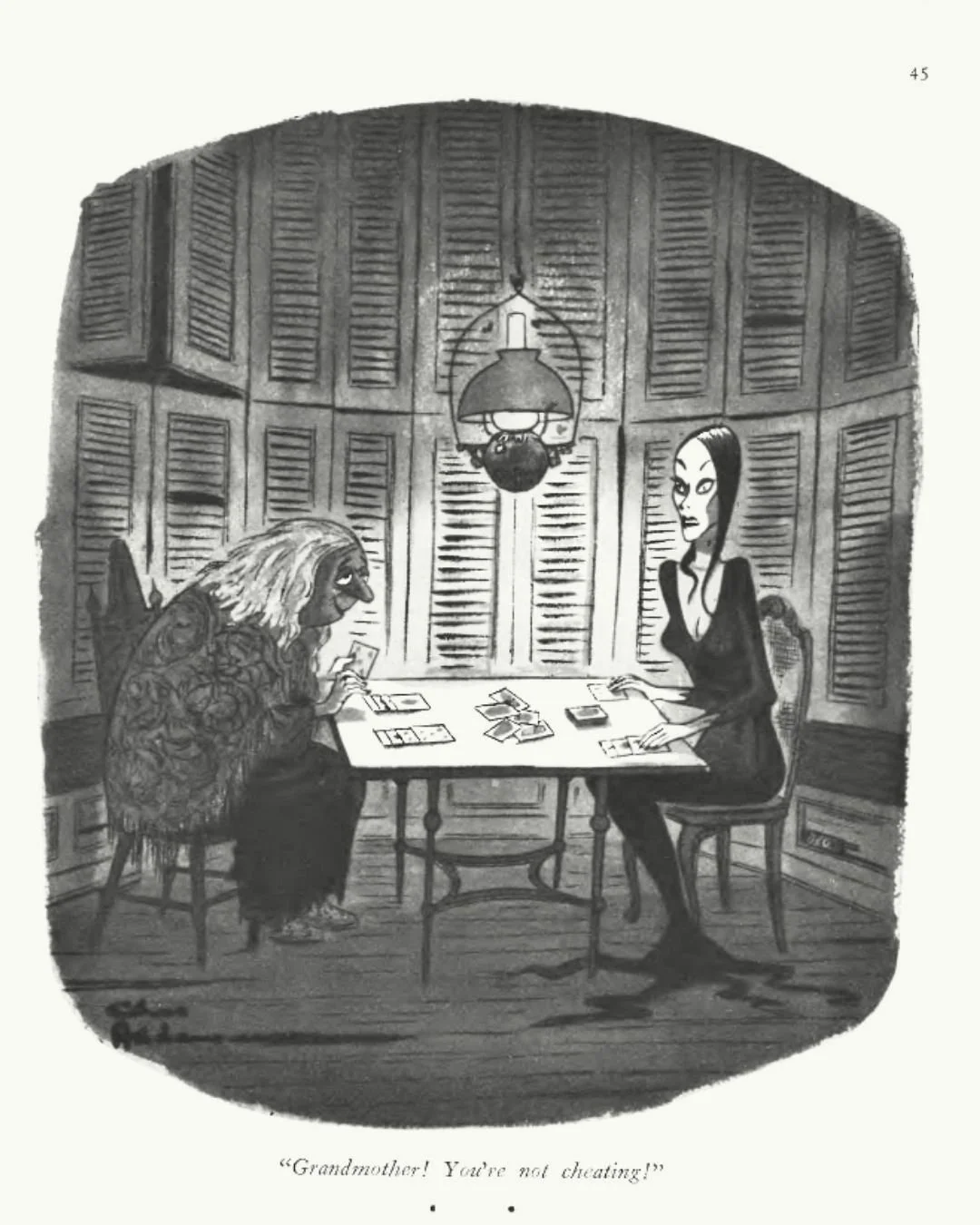
According to Charles Addams, Grandma Frump is a “disrespectful old hag” and “good humored about all and can be garrulous” (Miserocchi, 2010, p. 128). In the comics, she is Gomez’s mother, though her relationship to the Family changes throughout iterations of the franchise (Miserocchi, 2010, p. 128). Addams said she is a favorite of the children and “willingly helps with the dishes, cheats at solitaire and is thoroughly dishonest” (Miserocchi, 2010, p. 128). In the musical The Addams Family, Grandmama provides the truth serum that creates the chaos of the second act.
NEW YORKER CARTOONS FEATURING GRANDMA FRUMP
-
![]()
Addams, C. (1948, Jan. 10). “Grandma Frump does some sewing” [Illustration]. The New Yorker, p. 29. https://archives.newyorker.com/newyorker/1948-01-10/flipbook/028/.
-
![]()
Addams, C. (1948, Jan. 24). “Grandma Frump and the Addams children bake cookies” [Illustration]. The New Yorker, p. 23. https://archives.newyorker.com/newyorker/1948-01-24/flipbook/022/.
-
![]()
Addams, C. (1951, Apr. 14). “Then the dragon gobbled up the handsome young prince…” [Illustration]. The New Yorker, p. 37. https://archives.newyorker.com/newyorker/1951-04-14/flipbook/036/.
-
![]()
Addams, C. (1959, Oct. 17). “Grandmother! You’re not cheating!” [Illustration]. The New Yorker, p. 45. https://archives.newyorker.com/newyorker/1959-10-17/flipbook/044/.


The Beinekes
The Beinekes were invented for the musical and do not appear in any other adaptation. The cheery Ohioan trio represents the “normal” nuclear family the Addamses interact with in every iteration of the franchise.
LUCAS BEINEKE
Lucas Beineke is Wednesday’s beau from Ohio. Like his mother, Lucas is a hopeful romantic who enjoys writing poetry. However, unlike his parents, he shares a taste for the macabre, much like his beloved Wednesday. Still, he is a loyal son and hopes that his parents will be able to accept his engagement.
ALICE BEINEKE
Alice Beineke, mother to Lucas, is a slightly neurotic, but very kind, woman from Ohio who speaks in poems of love “when [she’s] depressed or feeling blessed” (Brickman & Elice, 2008). She represents the many stuck-up suburbanites the Addams Family encounters in previous iterations of the franchise, providing a “normal” foil to the “strange” Addamses. In contrast to the Addams family’s gothic garb, Alice exclusively dons yellow, which she calls the color of “the warming sun…the color of yumminess and fun” (Brickman & Elice, 2008).
MAL BEINEKE
Mal Beineke is Lucas’s stuffy, conservative father. While he once was a follower of the Grateful Dead, Mal exists at the polar opposite from the Addams Family and struggles to accept their eccentricities, as well as his own deeply hidden ones.
Works Cited
-
Bernstein, L. & Sondheim, S. (1957). “Maria” [Song]. In West Side Story (Original Broadway Cast). Columbia Records.
Collins, S. (2008, Oct. 1). The Hunger Games. Scholastic Press.
Debussy, C. & Haguenauer, J.L. (1998). “Suite bergamasque, L.75: No. 3, Clair de Lune” [Song]. On Debussy: Piano Music [Album]. Meridian Records.
Edwards, B. (Director). (1961). Breakfast at Tiffany’s [Film]. Jurow-Shepherd & Spinel Entertainment.
Greene, A. (2012, May 11). “The Top 25 Teen Idol Breakout Moments.” Rolling Stone. https://www.rollingstone.com/music/music-lists/teen-idol-breakouts-158080/frank-sinatra-1942-169439/.
Kelly, G. & Donen, S. (1952). Singin’ in the Rain [Film]. Metro-Goldwyn-Mayer.
Meyer, Stephenie. (2006, Sept. 6). Twilight. Little, Brown Books for Young Readers.
Miserocchi, H.K. (2010). The Addams Family, An Evilution. Pomegranate Communications.
Poryes, M., McNamara, S., Brookwell, D., Rinsler, D., & Warren, M. (Executive producers). (2003-2007). That’s So Raven [Television series]. It's a Laugh Productions; Brookwell McNamara Entertainment; Warren & Rinsler Productions.
Poryes, M. & Peterman, S. (Executive producers). (2006-2011). Hannah Montana [Television series]. It's a Laugh Productions & Michael Poryes Productions.
Rosa, C. (2016, Oct. 27). “17 Early 2000s Female Singers Who Were Responsible for Your Teenage Angst.” Glamour. https://www.glamour.com/story/best-early-2000s-female-singers.
Rogow, S., Minksy, T., Jansen, S.E., & Winter, R. (Executive Producers). (2001-2004). Lizzie McGuire [Television series]. Stan Rogow Productions.
Rowling, J.K. (1998, Sept. 1). Harry Potter and the Sorcerer’s Stone. Scholastic.
Schneider, D. (Executive producer). (2004-2007). Drake and Josh [Television series]. Schneider's Bakery & Nickelodeon Productions.
Schneider, D. & O’Dowd, B. (Executive producers). (2005-2008). Zoey 101 [Television series]. Schneider's Bakery & Nickelodeon Productions.
Schwahn, M., Davola, J., Prange, G., Tollin, M., & Robbins, B. (Showrunner). (2000-2007). One Tree Hill [Television series]. Tollin/Robbins Productions; Warner Bros. Television; Mastermind Laboratories.
Sherman-Palladino, A. & Palladino, D. (Executive producers). (2000-2007). Gilmore Girls [Television series]. Dorothy Parker Drank Here Productions & Warner Bros. Television.