
The Musical Influences of Hadestown
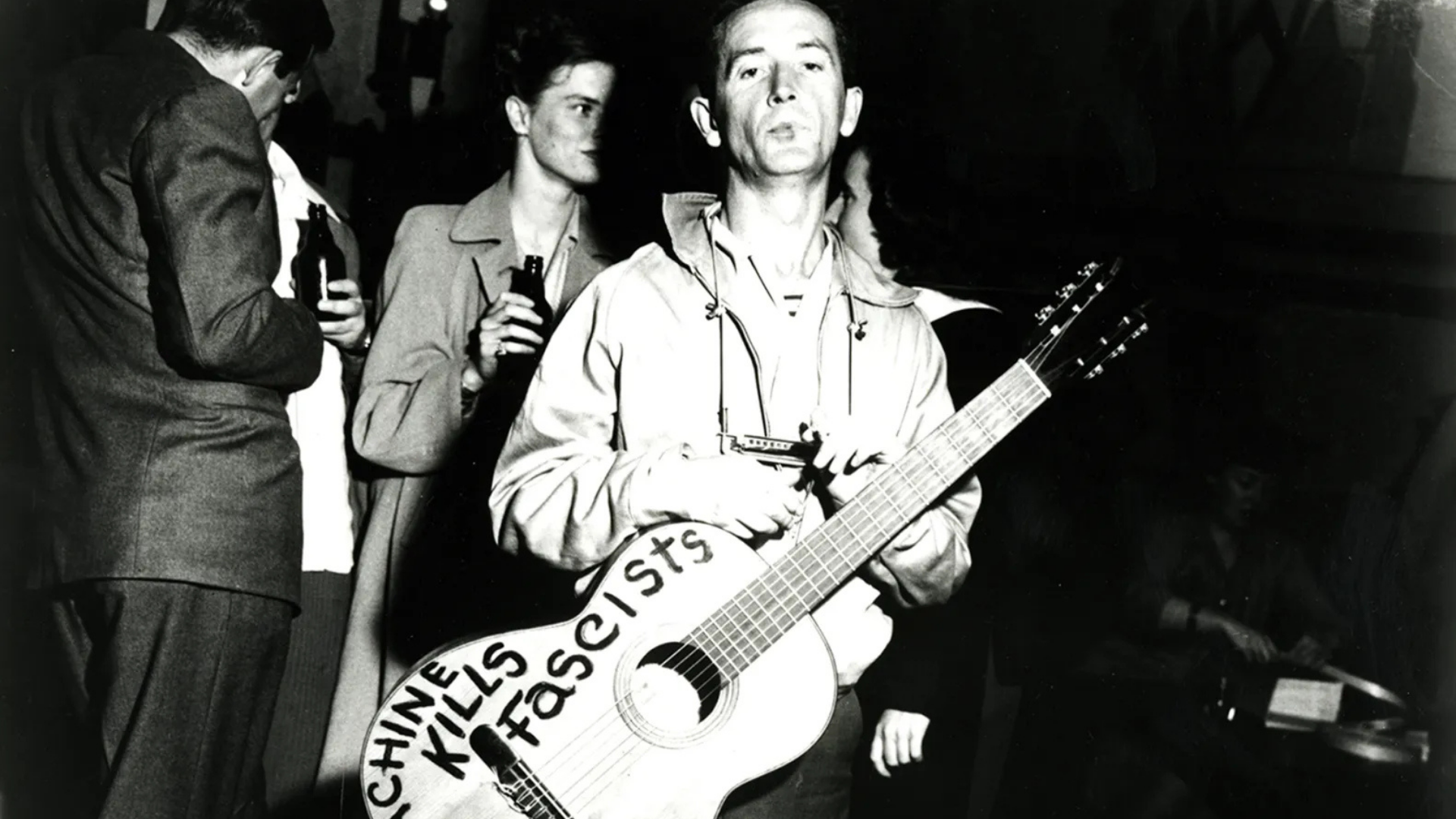
Folk legend Woody Guthrie
Browne, D. (2022, Feb. 25). “Woody Guthrie Up Close: See Artifacts From New Exhibit on the Folk Legend.” Rolling Stone.
American Folk Music
WOODY GUTHRIE
Legendary American folk artist Woody Guthrie became an early inspiration for Mitchell’s characterization of Orpheus (Mitchell, 2020, p. 17). Born on July 14, 1912 in Okemah, Oklahoma, Woodrow “Woody” Guthrie was a prolific singer-songwriter shaped by the Dust Bowl era (Mateus, 2012). As a teen, he left home and roamed the Plains, observing how the Great Dust Storm of the 1930s devastated farming communities and left thousands destitute. Eventually, Guthrie hitchhiked his way to Los Angeles, California and camped alongside other “Okie” Dust Bowl refugees (McCollum, 2019). There, Guthrie was able to make a living as a singer on the radio and began to develop his voice as an activist for California’s agricultural communities (Mateus, 2012).
Additional Resources to Learn More about the Dust Bowl
In congruence with the Ken Burns’s 2012 documentary The Dust Bowl, PBS created a full Dust Bowl unit for middle and high school students.
Dorothea Lange’s historic photography of destitute traveling farmers in California for the Resettlement Administration (RA), available to view at the Dorothea Lange Digital Archive
“This Land is Your Land”
During this time, Guthrie wrote his most famous song, “This Land Is Your Land.” While it is known as a blindly patriotic anthem now, Guthrie had more critical intentions. In 1939, Guthrie was driven mad by the popularity of Irving Berlin's saccharine “God Bless America” ruling the airwaves while poverty pillaged the country. In response, he penned “This Land Is Your Land” – originally “God Blessed America for Me” – to express his “love of the American landscape” while “point[ing] out that a lot of Americans weren’t feeling blessed at all” (McCollum, 2019). While excluded in the radio cut of the song, the following original refrains are especially prescient in the context of Anaïs Mitchell’s Hadestown:
“As I went walking, I saw a sign there,
And on the sign, it said ‘No Trespassing.’
But on the other side it didn't say nothing,
That side was made for you and me.
In the squares of the city, in the shadow of the steeple,
By the relief office I seen my people.
As they stood there hungry, I stood there asking
Is this land made for you and me?” (Guthrie, 1956).
![Berlin, I. (1939). “God Bless America” [Manuscript]. National Museum of American History. https://ids.si.edu/ids/deliveryService?id=NMAH-JN2021-04421-000001&max=600.](https://images.squarespace-cdn.com/content/v1/6515c98fe1bbd91be575282e/28fc03a8-eb5e-4846-9ee9-aa6a0cd78a05/God-Bless-America.png)
“God Bless America” by Irving Berlin
Berlin, I. (1939). “God Bless America” [Manuscript]. National Museum of American History.
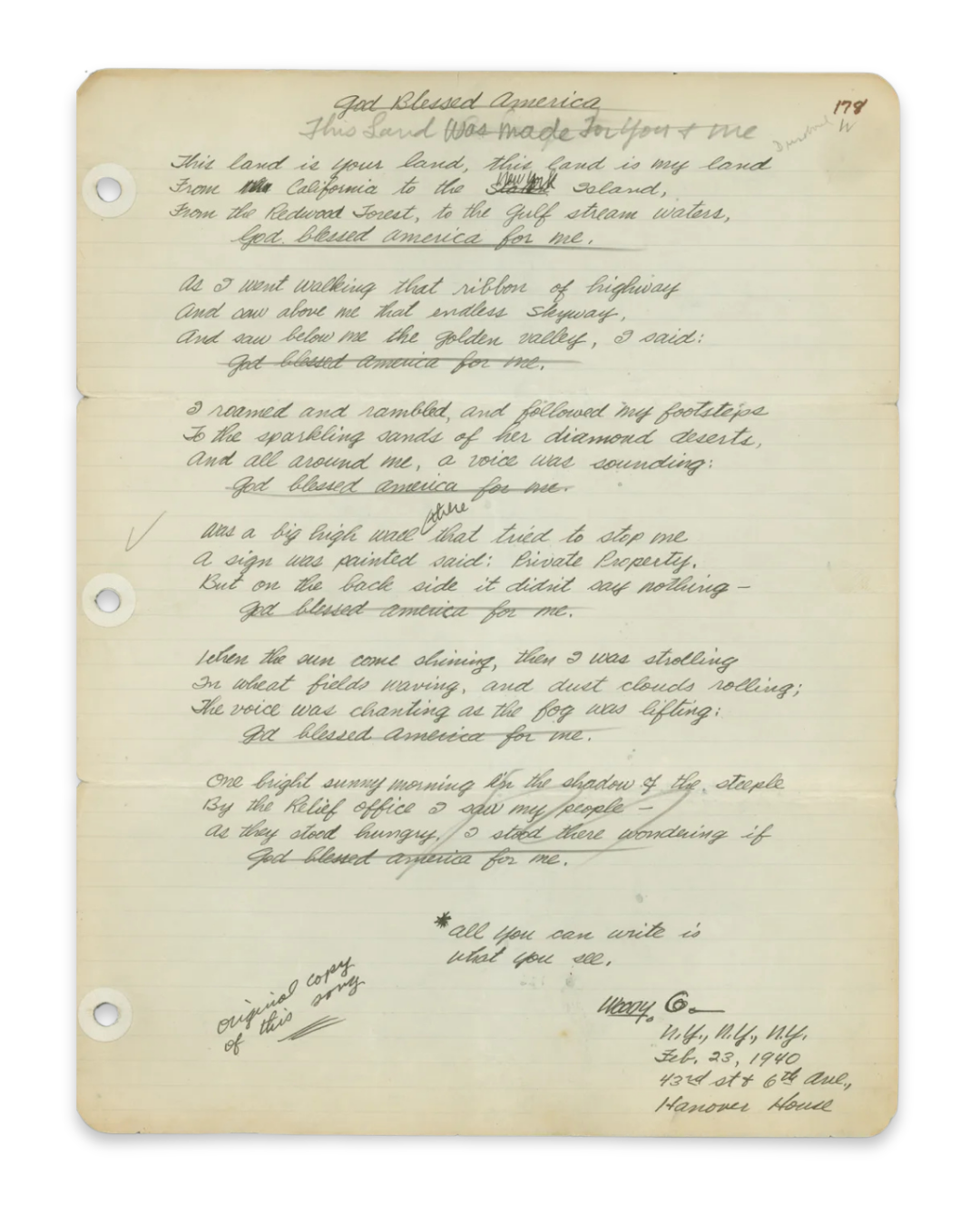
Original lyrics to “This Land Is Your Land” by Woody Guthrie
Browne, D. (2022, Feb. 25). “Woody Guthrie Up Close: See Artifacts From New Exhibit on the Folk Legend.” Rolling Stone.
This Machine Kills Fascists
Guthrie moved to New York City in late 1940, where he met other prominent folk voices – most notably, Millard Lampell, Bess Lomax, Pete Seeger, Arthur Stern, and Sis Cunningham. Together, they formed “The Almanac Singers,” a musical group dedicated to promoting “union organizing, anti-Fascism, strengthening the Communist Party, peace, and generally fighting for the things they believed…through songs of political protest and activism” (Mateus, 2012).
Later in the second World War, Guthrie enlisted as a Merchant Marine in the Army. His experience inspired him to write many songs opposing fascism and rallying the American troops, such as “All You Fascists Bound to Lose,” “Talking Merchant Marine,” and “The Sinking of the Reuben James” (Mateus, 2012; McCollum, 2019).
Woody Guthrie wrote nearly 3,000 lyrics and published two novels in his lifetime, and his impact is felt throughout American music history (Mateus, 2012; McCollum, 2019). Upon his impending death in 1967, then-up-and-coming folk artists Joan Baez, Bob Dylan, The Greenbriar Boys, Phil Ochs, and others visited his hospital bedside to thank him with song for his life’s work (Mateus, 2012).
1960s-1970s FOLK MUSIC
Anaïs Mitchell grew up listening to Bob Dylan, Leonard Cohen, and Joni Mitchell records and attended local music festivals in Vermont with her father (Browne, 2019). In fact, Mitchell specifically credits Bob Dylan as her “bible” growing up in rural Vermont (Van der Ven, 2019). Their impact, as well as that of their contemporaries, are felt throughout the score of Hadestown as characters desperately lament over fragile love and search for a song to save the world.
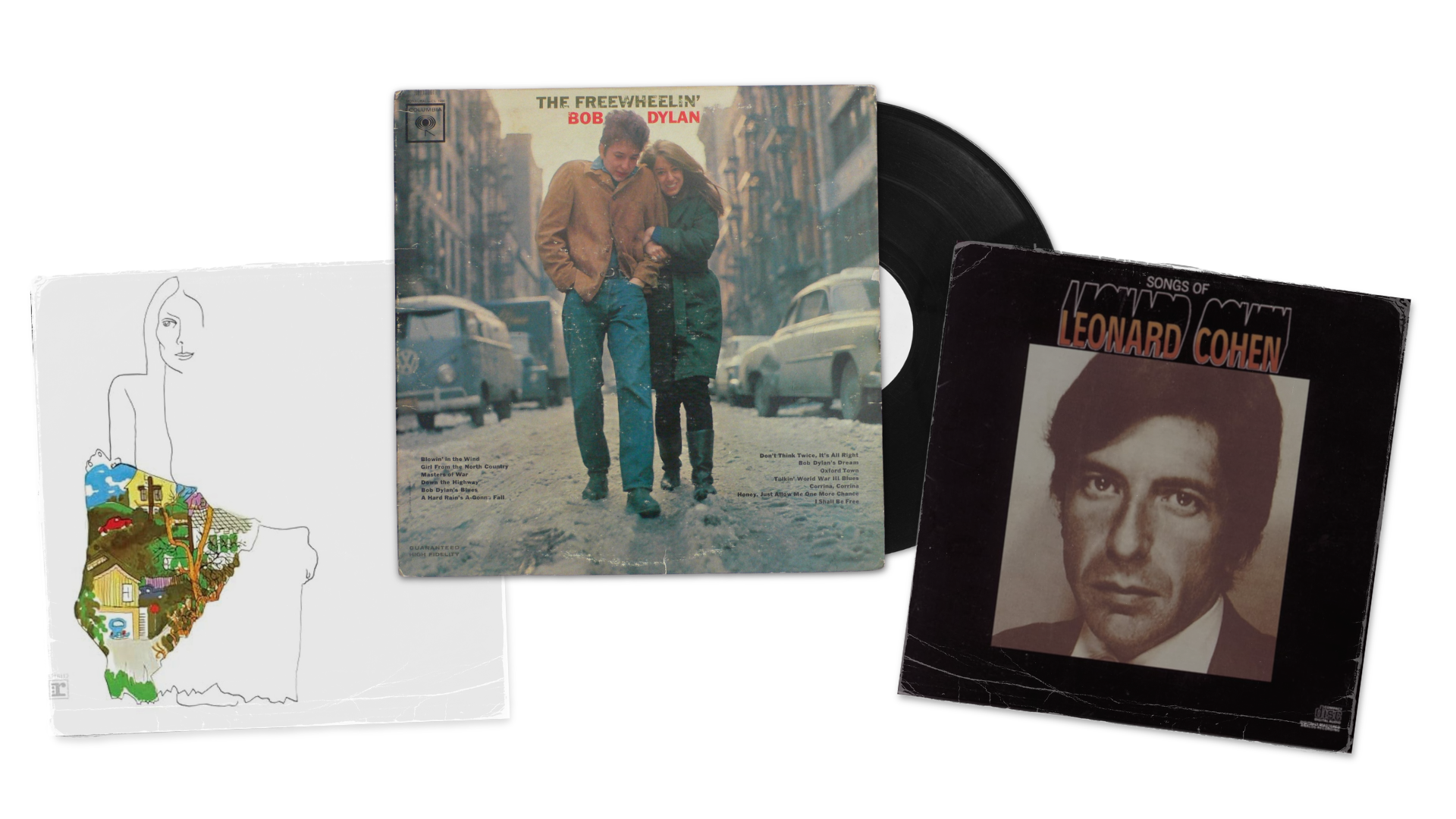
Some of Anaïs Mitchell’s favorite records
Mitchell, J. (1970, June 22). Ladies of the Canyon [Album]. Reprise Records. | Dylan, B. (1963, May 27). The Freewheelin' Bob Dylan [Album]. Columbia Records. | Cohen, L. (1967, Dec. 27). Songs of Leonard Cohen [Album]. Columbia Records.
![“Midnight Preserves” [Image]. (2026). Preservation Hall Foundation. https://images.squarespace-cdn.com/content/v1/548a3b8ae4b04308d751c7ac/c3bdd95e-5c93-4083-9a7b-34c11a611125/Charlie+MP.jpg?format=2500w.](https://images.squarespace-cdn.com/content/v1/6515c98fe1bbd91be575282e/2f5119a1-bd10-4d07-8ebe-8909a2e63288/PreservationHall-JazzBand.png)
The Preservation Hall Jazz Band in New Orleans
“Midnight Preserves” [Image]. (2026). Preservation Hall Foundation.
American Jazz Music
NEW ORLEANS JAZZ
New Orleans Jazz, also known as “Dixieland Jazz” or “hot jazz,” is a form of American Jazz music that emerged in the early 20th century blending blues, ragtime, gospel, and military marching band styles (Tyler, 2025; “Jazz in America,” n.d.). The standard instrumentation of a Dixieland Jazz band is a trumpet or cornet; a clarinet; a trombone; a piano; a string bass or tuba; a banjo or guitar; and a drum (“Jazz in America, n.d.; “The Impression of Dixieland Jazz on New Orleans,” 2014). Traditionally, the musicians would collectively improvise without a single leader or solos; however, the genre evolved to feature individual jazz solos in accordance with mainstream jazz (Tyler, 2025).
![Lee, F. (2008, Jan. 27). “Front door of the Preservation Hall” [Image]. Wikimedia Commons. https://commons.wikimedia.org/wiki/File:PreservationHall_2008.jpg#/media/File:PreservationHall_2008.jpg.](https://images.squarespace-cdn.com/content/v1/6515c98fe1bbd91be575282e/fa189521-9d7d-420b-a9d5-47f509216440/PreservationHall-Exterior.png)
Exterior of Preservation Hall
Lee, F. (2008, Jan. 27). “Front door of the Preservation Hall” [Image]. Wikimedia Commons.

Preservation Hall Jazz Band
Director Rachel Chavkin specifically cites Preservation Hall in New Orleans as a major source of inspiration for the original Broadway production of Hadestown (Broadway.com, 2019). Preservation Hall, home to the Preservation Hall Jazz Band, is a historic music venue founded in 1961 in the heart of the French Quarter (Our History, n.d.). Since then, it has provided almost nightly jazz jam sessions.
The French Quarter
Music can be found all around the streets of New Orleans, though. For example, Dr. Doreen J. Ketchens is a modern legendary New Orleans street jazz clarinetist and bandleader who has performed on the national stages (About Us, 2020). Her famous street performances with her band Doreen's Jazz New Orleans in the French Quarter best capture the energy Anaïs Mitchell hoped to bring to Hadestown (Carol Caffe, 2014; MissJessicaB, 2018).
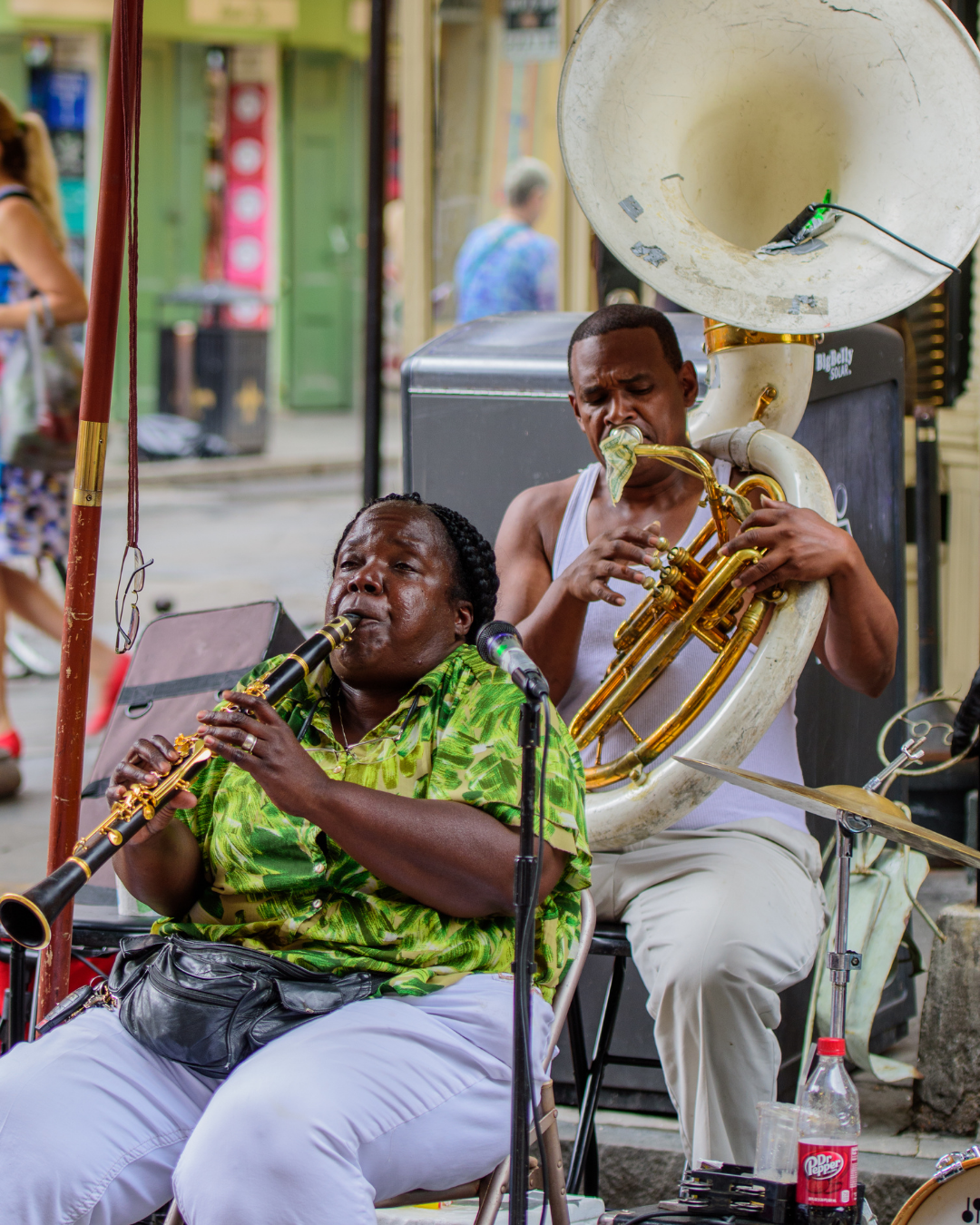
Dr. Doreen J. Ketchens performing in the French Quarter
David Kabot. (2016, May 7). “_D8X5409 Doreen Ketchens, The Clarinet Queen” [Image]. Flickr.
Works Cited
-
Browne, D. (2022, Feb. 25). “Woody Guthrie Up Close: See Artifacts From New Exhibit on the Folk Legend.” Rolling Stone. https://www.rollingstone.com/music/music-pictures/woody-guthrie-exhibit-morgan-library-1312330/.
Guthrie, W. (1956). “This Land Is Your Land.” TRO-Ludlow Music, Inc.
Mateus, J.A. (2012). “About Woody Guthrie.” Woody Guthrie. https://woodyguthrie.org/biography.htm.
McCollum, S. (2019, Sept. 17). “This Land Is Your Land” (L. Resnick, Ed.). Kennedy Center Education. https://www.kennedy-center.org/education/resources-for-educators/classroom-resources/media-and-interactives/media/music/story-behind-the-song/the-story-behind-the-song/this-land-is-your-land/.
Mitchell, A. (2020). Working on a Song: The Lyrics of Hadestown. Penguin Random House.
-
Browne, D. (2019, June 1). “The Hell With Broadway: The Story of Anais Mitchell’s ‘Hadestown.’” Rolling Stone. https://www.rollingstone.com/music/music-features/broadway-hadestown-best-musical-tony-anais-mitchell-842447/.
Cohen, L. (1967, Dec. 27). Songs of Leonard Cohen [Album]. Columbia Records.
Dylan, B. (1963, May 27). The Freewheelin' Bob Dylan [Album]. Columbia Records.
Mitchell, J. (1970, June 22). Ladies of the Canyon [Album]. Reprise Records.
Van der Ven, M. (2019, May 24). “Anaïs Mitchell.” The Influences. https://theinfluences.com/anais-mitchell/.
-
About Us. (2020). Doreen's Jazz New Orleans. https://www.doreensjazz.org/about.
Biscontini, T. (2025). “Dixieland (Music).” EBSCO. https://www.ebsco.com/research-starters/music/dixieland-music.
Broadway.com. (2019, Jun. 4). BUILDING BROADWAY: HADESTOWN Book & Songwriter Anaïs Mitchell and Director Rachel Chavkin [Video]. YouTube. https://youtu.be/xclbKf6qIrI?si=K3xV54bMP5RxdUk1.
Carol Caffe. (2014, Feb. 10). The House of The Rising Sun - Doreen's Jazz Band [Video]. YouTube. https://youtu.be/a3SODvwZ8AM?si=JUlKEvRhdddJ0b2Q.
“Dixieland Jazz New Orleans.” (n.d.). New Orleans. https://www.neworleans.com/things-to-do/music/history-and-traditions/dixieland-jazz-new-orleans/.
MissJessicaB. (2018, Nov. 26). Doreen Ketchens: Hit the Road Jack, New Orleans Jazz [Video]. YouTube. https://youtu.be/i6Hbiebo25A?si=kSZxEFP8CcNWzPTD.
“Our History.” (n.d.). Preservation Hall Foundation. https://www.preshallfoundation.org/history.
Raeburn, B.B. (n.d.). “Dixieland/Early Jazz.” Mosaic Records. https://www.mosaicrecords.com/dixieland-jazz/.